Telling Disc Pain From DM in a Corgi
It’s an agonizing moment for any Corgi parent: you notice a subtle change in your beloved furry friend's gait, a new reluctance to jump, or perhaps even a full-blown collapse. Your mind immediately races to all the scary possibilities, and two of the most concerning—and often confused—conditions for our long-backed, short-legged companions are disc pain (Intervertebral Disc Disease, or IVDD) and Degenerative Myelopathy (DM). Understanding the subtle yet critical differences between these two can make all the difference in seeking the right diagnosis and treatment.
Understanding the Nature of Disc Pain in Corgis
Corgis, with their distinctive long backs and short legs, are unfortunately predisposed to spinal issues, particularly Intervertebral Disc Disease (IVDD). This condition is often likened to a slipped or herniated disc in humans, but in our canine friends, it happens due to the unique chondrodystrophic gene that affects their cartilage development, making their discs more prone to degeneration at an earlier age.
What Happens During a Disc Incident
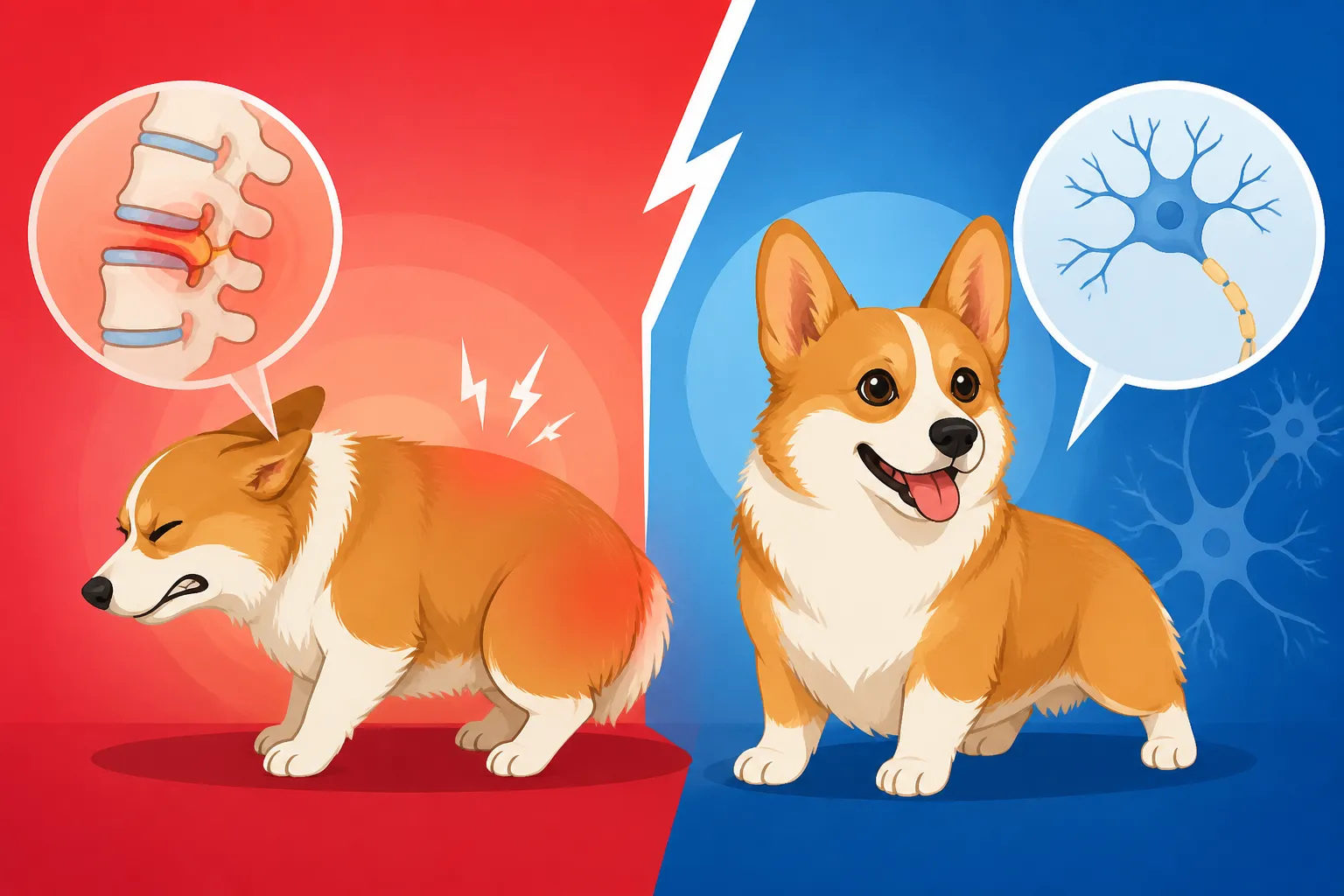
Imagine the discs between your Corgi's vertebrae as tiny, jelly-filled donuts that act as shock absorbers. With IVDD, these discs can either bulge out or rupture entirely, pressing on the spinal cord. This pressure can range from causing mild discomfort to severe pain, paralysis, or even permanent nerve damage. The onset is often sudden, dramatic, and intensely painful. One minute your Corgi might be chasing a squirrel, and the next, they're yelping in pain, unable to move their hind legs. This suddenness is a hallmark of an acute disc episode. It's truly heartbreaking to witness, and for many owners, this is when they realize that their Corgi's back is built the way it is, making them vulnerable.
A disc incident isn't always a single, isolated event either. Some Corgis experience chronic disc degeneration, where the discs slowly calcify and harden over time, becoming less flexible and more susceptible to injury. Then, one wrong jump or twist can trigger a full-blown crisis. If you’ve ever wondered about The Jump That Ruptures a Corgi Disc, you know how quickly things can escalate. The pain from IVDD is neuropathic and inflammatory, causing significant distress to your dog.
Common Symptoms of Corgi Disc Pain
When a Corgi is suffering from disc pain, the symptoms tend to be very clear-cut and often involve overt signs of discomfort. They might cry out when lifted, refuse to move, or adopt a hunched posture. You might notice them shaking or trembling, which is often a sign of intense pain. A Corgi with a bad back often avoids stairs, stops jumping on the sofa, or struggles with their usual agility.
One of the most noticeable signs is a change in their mobility, specifically weakness or paralysis in the affected limbs. If the disc issue is in the mid-back, you'll see hind leg weakness, while neck disc problems can affect all four limbs. Some Corgis might drag one back foot, scuffing their nails, or their back legs might cross over when they try to walk. The severity of these symptoms usually correlates directly with the degree of spinal cord compression. An immediate call to your vet is crucial if you suspect an injury, as Emergency Signs of a Corgi Disc Injury require prompt attention to minimize long-term damage.
Understanding Degenerative Myelopathy in Corgis
Degenerative Myelopathy (DM) is a cruel, progressive neurological disease that affects the spinal cord, specifically the white matter, leading to a gradual loss of coordination and strength in the hind limbs. Unlike IVDD, which is a structural problem, DM is a genetic condition, a neurodegenerative disorder. It’s often a very different beast to contend with, both emotionally and medically.
What Happens with DM Progression
DM is insidious because it progresses slowly and painlessly. It’s caused by a mutation in the SOD1 gene, and while many Corgis may carry the gene, not all develop the disease. For those that do, it typically manifests in middle to older age, usually between 8 and 14 years old, which are often The Corgi Years When the Back End Gives Out. The disease attacks the myelin sheath, which is the protective covering around nerve fibers in the spinal cord, much like insulation on an electrical wire. As this myelin degenerates, nerve signals can't transmit properly from the brain to the hind limbs.
This progressive nature means that symptoms start subtly and worsen over months to years. It's not a sudden crisis but a slow, steady decline. This can be particularly frustrating for owners because, in the early stages, it might just look like "getting old." There's no inflammation or pain involved directly from the DM itself, which is a major differentiator from acute disc pain. However, as mobility decreases, secondary issues like muscle strain or sores can certainly cause discomfort. For those with a Corgi already in their golden years, managing Pain Relief for an Old Corgi's Back becomes a vital part of their care plan.
Initial Signs and Progression of DM
The First Signs of DM in a Corgi are often so subtle that they can be easily missed or attributed to age. You might notice slight clumsiness in the hind legs, a tendency to scuff their nails on one or both back paws, or a slight swaying when standing still. The early signs are almost always asymmetrical, meaning one leg might be a little weaker or less coordinated than the other. Over time, this weakness progresses, leading to more pronounced instability, difficulty getting up, and eventually, the inability to walk.
As the disease advances, your Corgi will lose proprioception – their awareness of where their limbs are in space. They might cross their back legs over each other while walking, stand with their hocks touching, or drag their paws. Eventually, they will become paraplegic, meaning they cannot use their hind legs at all. The progression from the first stumble to needing a cart can span The Months Between a Corgi's First Stumble and a Cart, highlighting the relentless nature of this disease. While the physical decline is profound, their minds usually remain sharp and alert, making the situation even more heartbreaking.
Key Differences in Symptoms and Onset
Distinguishing between disc pain and DM is crucial for effective treatment. While both conditions primarily affect the hind limbs and are common in Corgis, their origins, pain levels, and progression patterns are vastly different.
Let's look at a quick comparison:
| Feature | Intervertebral Disc Disease (IVDD) | Degenerative Myelopathy (DM) |
|---|---|---|
| Onset | Often sudden, acute, can be triggered by a specific movement | Gradual, insidious, slowly progressive over months/years |
| Pain | Typically present, ranging from mild discomfort to severe, acute pain | Usually painless in early stages, pain comes from secondary issues |
| Progression | Can be sudden paralysis or chronic intermittent pain; may improve with treatment | Slowly progressive, irreversible decline in mobility |
| Symmetry | Can be unilateral (one side) or bilateral (both sides), depending on disc location | Often asymmetrical in early stages, becoming more symmetrical later |
| Reflexes | May have exaggerated or absent reflexes depending on nerve compression | Reflexes often normal or exaggerated in early stages, loss later |
| Cause | Structural issue: disc bulging or rupture, common in chondrodystrophic breeds | Genetic neurological disorder (SOD1 gene mutation) |
| Age of Onset | Can occur at any age, but more common in middle-aged Corgis (3-7 years) | Typically older dogs (8+ years) |
| Prognosis | Can improve with rest, medication, or surgery; may recur | Incurable and progressive, leading to full paralysis |
The Pain Factor: A Primary Indicator
The most significant difference that often helps differentiate these two conditions is the presence or absence of pain. With IVDD, pain is almost always a prominent feature, especially during an acute episode. Your Corgi will show clear signs of distress – yelping, crying, guarding their back, refusing to be touched, or shivering. They might even become aggressive due to the intense pain. This pain response is a direct result of the disc compressing the sensitive spinal cord or nerve roots.
DM, on the other hand, is generally considered a non-painful condition in its early to mid-stages. The degeneration of nerve fibers itself doesn't cause pain. What you'll see instead is a progressive loss of motor function and coordination. A Corgi with DM might not yelp when you touch their back or show signs of acute discomfort when moving, even though their legs are weakening. If pain does develop in a DM dog, it's usually due to secondary issues like muscle atrophy, compensatory strains, or pressure sores from immobility, not the myelopathy itself. This distinction is vital for veterinarians during their initial assessment.
Onset and Progression: Sudden vs. Gradual
Another key differentiator is the speed and pattern of symptom onset. IVDD tends to strike suddenly, often after a specific movement like jumping, twisting, or even just landing awkwardly. One day your Corgi is fine, and the next they are in severe pain and can't use their back legs. While there can be chronic, low-grade disc issues, the acute presentations are often dramatic. Recovery from an IVDD episode, whether through conservative management or surgery, can also be quite swift, though recurrence is a concern. For some Corgis, a period of Crate Rest for a Corgi With a Bad Back might be enough, while others might require more invasive intervention.
DM, conversely, is characterized by its slow, relentless progression. It's a creeping condition that slowly erodes your Corgi's mobility over months or even years. You might first notice a slight dragging of a back paw, which then progresses to wobbliness, then difficulty standing, and eventually paralysis. This gradual decline is often what makes it so hard for owners to pinpoint the exact start date of the problem. If you're observing your Corgi's mobility closely, you might notice subtle changes around The Age Corgi Disc Problems Usually Appear, which can sometimes overlap with DM onset ages, adding to the confusion.
Diagnostic Approaches and Management
Because the symptoms can appear similar in the initial stages, a thorough veterinary examination, often involving a neurologist, is essential to differentiate between IVDD and DM. Accurate diagnosis is paramount because the treatment and prognosis for each condition are vastly different.
Veterinary Examination and Imaging
When you bring your Corgi to the vet with hind limb weakness or pain, the vet will start with a comprehensive neurological exam. What a Neurologist Checks in a Corgi involves assessing gait, reflexes, proprioception, and pain response. The results of this exam can often point towards either a spinal cord compression (like IVDD) or a more diffuse neurological problem (like DM). For instance, a Corgi with disc pain might exhibit pain upon palpation of the spine and a loss of voluntary motor function. A Corgi with DM might have intact or even exaggerated reflexes initially, despite significant weakness and poor proprioception.
To confirm IVDD, imaging such as X-rays, myelography, CT scans, or MRI are typically used. An MRI is considered the gold standard as it can clearly visualize the soft tissues, including the spinal cord and discs, showing any compression. These images allow the vet to pinpoint the exact location and severity of the disc herniation, which is crucial for surgical planning if needed.
For DM, definitive diagnosis is more complex. There's a genetic test for the SOD1 gene mutation, which can tell you if your Corgi is "at-risk" (carrying two copies of the mutation). However, a positive genetic test alone doesn't mean your Corgi has DM; it only means they are predisposed. The true diagnosis of DM is often one of exclusion – meaning other conditions, especially treatable ones like IVDD, are ruled out first. Sadly, confirmation of DM traditionally requires a post-mortem examination of spinal cord tissue. While this is changing, current methods mostly rely on clinical signs and ruling out other diseases to arrive at a presumptive diagnosis. If you're looking into genetic testing, several reputable labs, such as those that partner with Healthy Paws for health screenings, can provide accurate results for The DNA Tests a Corgi Breeder Should Run.
Treatment and Management Strategies
The management of IVDD and DM differs dramatically because one is a structural issue and the other is a progressive neurological disease.
For IVDD:
Treatment for disc pain often involves either conservative management or surgery.
- Conservative Management: This usually means strict crate rest for several weeks (typically 4-6 weeks), combined with anti-inflammatory medications, pain relievers, and muscle relaxants. The goal is to reduce swelling and allow the disc to heal. This can be a challenging period, but it's often effective for milder cases. This option can be considered when asking Whether a Corgi Needs Surgery or Rest.
- Surgery: For more severe cases, especially those with significant neurological deficits or paralysis, surgery to remove the herniated disc material and decompress the spinal cord is often recommended. Post-operative care includes intense physical therapy, hydrotherapy, and a strict rehabilitation regimen to help the Corgi regain strength and mobility. Pet insurance providers like Healthy Paws can be incredibly helpful in mitigating the substantial costs associated with IVDD diagnostics and surgery.
For DM:
Unfortunately, there is no cure for Degenerative Myelopathy. The focus of management is on maintaining quality of life, slowing progression where possible, and providing supportive care.
- Physical Therapy and Exercise: Regular, controlled exercise and physical therapy, including hydrotherapy, can help maintain muscle mass, strengthen remaining neurological pathways, and improve proprioception. This can involve specific exercises, massage, and assisted standing. Physiotherapy for a Corgi Losing Its Legs can be crucial for maintaining mobility for as long as possible.
- Mobility Aids: As the disease progresses, Corgis may benefit from mobility aids such as slings, harnesses, and eventually, custom-fitted wheelchairs or carts. These devices allow them to remain active and engaged in life, even when their hind legs no longer cooperate.
- Nutritional Support: While no specific diet cures DM, a well-balanced, high-quality diet, often supplemented with antioxidants and omega-3 fatty acids, can support overall neurological health.
- Environmental Modifications: Making your home more accessible with ramps, non-slip rugs, and comfortable orthopedic beds can significantly improve your Corgi's comfort and safety.
It’s vital to work closely with your veterinarian and a veterinary neurologist to create the best care plan for your Corgi, whether they are battling disc pain or navigating the challenges of DM. Early and accurate diagnosis gives your Corgi the best chance at managing their condition and maintaining their quality of life.
Disclaimer
The information provided in this article is for general informational purposes only and is not a substitute for professional veterinary advice. Always consult with a qualified veterinarian or animal health professional for any medical concerns or before making any decisions about your Corgi's health and treatment.