Whether the Cardigan Came From the Teckel Family
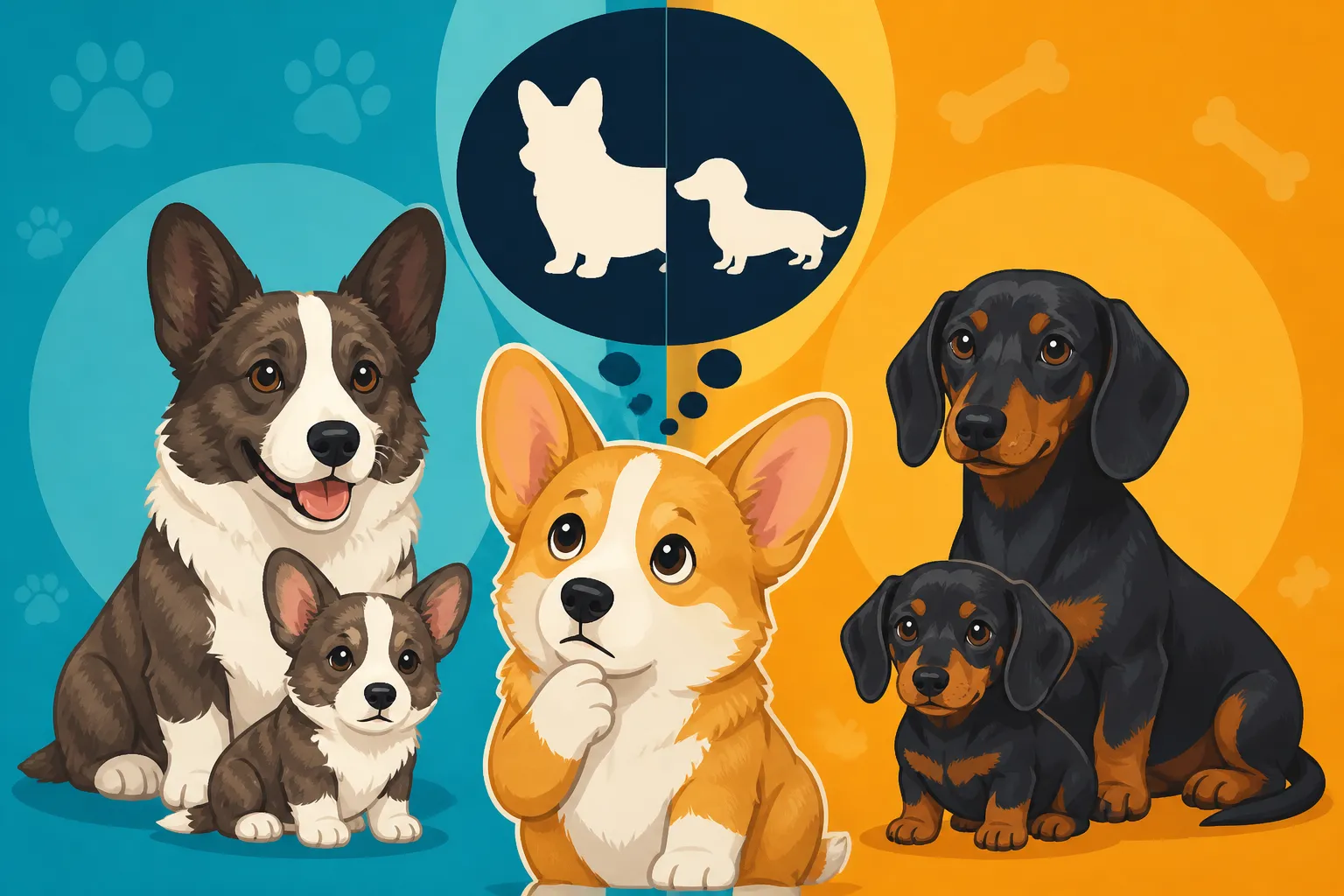
It’s natural to look at a Cardigan Welsh Corgi, with its long, low body and adorable short legs, and wonder about its family tree. Many people see those familiar proportions and immediately think of a Dachshund, often leading to the question of whether the Cardigan came from the "Teckel family." This isn't a silly thought at all; the visual similarities are striking, and it’s a perfectly reasonable line of inquiry for anyone curious about this wonderful breed's deep history. This guide will delve into the origins of the Cardigan Welsh Corgi, exploring the historical theories, genetic evidence, and distinguishing characteristics that help clarify its ancestral lineage and answer whether it truly shares a direct heritage with the Dachshund.
Understanding the "Teckel Family" Connection
The idea that the Cardigan Welsh Corgi might be related to the "Teckel family" isn't just a fleeting thought for many; it stems from clear visual cues that even experienced dog enthusiasts notice. Let's unpack what the "Teckel family" actually refers to and why the comparison is so persistent.
What is the "Teckel Family"?
When we talk about the "Teckel family," we are essentially referring to the Dachshund breed. "Teckel" is actually the German word for Dachshund, and it literally translates to "badger dog," which gives you a huge clue about their original purpose! These dogs were bred in Germany centuries ago specifically to hunt badgers and other burrowing animals. Their unique physique – that famously long body, short legs, and a tenacious spirit – was perfectly engineered for digging into burrows and flushing out prey. They needed to be low to the ground to follow scent trails into tunnels and robust enough to handle a feisty badger.
So, when people make the connection between a Cardigan and the "Teckel family," they're drawing a link to the Dachshund and its distinctive shape and historical function. It’s not just about aesthetics; it’s about a body type that suggests a particular kind of working dog, often one built for tight spaces or demanding terrain. The Cardigan's sturdy build, deep chest, and well-muscled legs, despite their shortness, often echo the strong, determined look of a Dachshund.
The Visual Similarities: Why the Question Arises
It's undeniable: both the Cardigan Welsh Corgi and the Dachshund possess that iconic "long and low" silhouette. This shared physical characteristic is the primary driver behind the question of a shared lineage. You see a Cardigan trotting along, its body close to the ground, and it's easy to picture a Dachshund walking alongside it. Both breeds feature relatively short, stout legs compared to their elongated torsos. This body type, known as chondrodystrophy, is what gives them their unique charm and also leads to certain shared health considerations, especially concerning their backs.
Beyond the overall shape, there are other similarities that can spark this connection. For example, some Cardigans have ears that, while often more upright than a Dachshund's typical floppy ear, can sometimes have a softer set that might remind an observer of the badger dog. Their expressive faces, often framed by alert, intelligent eyes, also share a certain charm. It's truly a case where form factor immediately brings another breed to mind, creating a natural curiosity about their shared history. For a deeper dive into their physical form, you might find The Corgi Body the Standard Describes interesting.
The Common Misconception and Early Theories
For a long time, before the advent of modern genetic testing, the assumption was often made that if two breeds looked very similar, they must be related. This was especially true for breeds sharing such a distinctive trait as chondrodystrophy. Early theories about the Cardigan's origins sometimes speculated on crosses with Dachshunds or other "Teckel-type" dogs, simply because of the low-slung body. It seemed like the most logical explanation for why a dog from Wales would end up with a physique so reminiscent of a German hunting dog.
People would imagine ancient Welsh farmers encountering Dachshunds, perhaps brought over by travelers or traders, and then breeding them with their local herding dogs to achieve a more efficient low-to-the-ground worker. This kind of anecdotal history, passed down through generations of dog lovers, often becomes ingrained. The idea was that the "Teckel type" was so unique that it had to be a direct import or a very close relative. However, as we'll explore, scientific understanding has brought a different perspective to these long-held beliefs, showing us that similar traits can evolve independently for similar reasons, without direct genetic ties.
Delving into Cardigan Welsh Corgi Origins
To truly understand whether the Cardigan Welsh Corgi is part of the "Teckel family," we need to look at its own deep, fascinating history. The Cardigan's story is one of ancient lineage, geographical isolation, and a distinct purpose that shaped its very being long before modern dog breeding took hold.
The Ancient Roots of the Cardigan
The Cardigan Welsh Corgi isn't just an old breed; it's considered one of the oldest dog breeds originating in the British Isles, with a history that stretches back perhaps as far as 1,200 BC. That's right, we're talking about a dog with roots potentially going back over three millennia! These dogs were the loyal companions and indispensable workers of farmers in Cardiganshire, Wales. Their primary role was as a drover's dog – herding cattle, sheep, and ponies from the high pastures to market. Imagine these small, sturdy dogs, darting beneath the hooves of much larger animals, nipping at their heels to guide them without getting trampled. This demanded immense courage, agility, and that signature low stature. For more on their ancient history, check out The Cardigan's Twelve Hundred BC Origins.
This deep history predates many of the continental European breeds we know today, including the modern Dachshund as a clearly defined breed. The Cardigan's development was tied intrinsically to the needs of the Welsh landscape and its people, evolving in relative isolation, shaped by the demands of agricultural life rather than specific crossbreeding programs with foreign dogs.
Geographic Isolation and Breed Development
Cardiganshire, the ancestral home of the Cardigan Welsh Corgi, is a famously rugged and mountainous region in southwest Wales. This geographical isolation played a crucial role in the development and preservation of the Cardigan as a distinct breed. With natural barriers limiting travel and interaction with other regions, the local dogs were largely kept to themselves, minimizing the introduction of outside bloodlines. This meant that the traits best suited for herding cattle in that specific terrain were consistently bred for, reinforcing the Cardigan's unique characteristics over centuries.
Think of it like a natural selection process, guided by human purpose. The dogs that were best at dodging kicks, navigating rocky slopes, and driving stubborn livestock were the ones farmers kept and bred. This consistent selection pressure, within a relatively closed gene pool, allowed the Cardigan's type to solidify. It wasn't about mixing different breeds from far-off lands; it was about refining and perfecting the existing local stock for its specialized job. This long period of isolated development is a strong argument against a recent or direct influence from the "Teckel family."
Early Written Records and Descriptions
While definitive "breed standards" are a relatively modern invention, looking at early written records and historical accounts can offer clues about a breed's past. Descriptions of dogs resembling Cardigan Corgis can be found in ancient Welsh texts and folklore, depicting small, intelligent dogs used for herding and guarding. These descriptions consistently point to a dog with an ancient presence in Wales, one that was integral to farm life.
What these records generally don't suggest is a sudden influx of a foreign "Teckel-type" dog influencing the local stock. Instead, they paint a picture of a consistent, evolving lineage of native Welsh dogs. The "Teckel family" connection would require a significant historical event of cross-breeding that isn't typically supported by the historical narrative of the Cardigan. Their heritage is more about continuity and adaptation within their Welsh homeland than an external genetic merge. For fascinating details on their historical roles, see What a Welsh Corgi Did on a Farm All Day. Even practical aspects of dog care, like what you might find on Chewy for ancient breeds, rely on understanding these historical dietary and activity needs.
Genetic Insights and Modern Breed Analysis
In the past, understanding a dog breed's ancestry was largely based on visual similarities, historical records, and educated guesses. However, modern science, particularly DNA analysis, has revolutionized our ability to trace canine lineages with incredible precision. This scientific lens offers compelling evidence regarding the Cardigan Welsh Corgi's true heritage.
The Power of DNA Testing in Breed Ancestry
Dog DNA testing, much like human ancestry tests, works by analyzing specific markers in a dog's genetic code. By comparing these markers across thousands of individual dogs and different breeds, scientists can build detailed family trees and identify shared ancestry. When two breeds share a common ancestor, their DNA will show distinct similarities. Conversely, if two breeds look alike due to convergent evolution (meaning they developed similar traits independently to suit similar environments or jobs), their DNA will reveal very different genetic backgrounds.
This is where the real clarity comes into play for the Cardigan and the "Teckel family." Instead of relying on how dogs look, we can now understand how they are genetically wired. This allows us to move beyond superficial resemblances and delve into the deep genetic tapestry that connects or separates different canine populations. For breeders, understanding these genetic links is crucial, which is why The DNA Tests a Corgi Breeder Should Run are so important.
What Genetic Studies Tell Us About Cardigan Ancestry
Modern genetic studies consistently place the Cardigan Welsh Corgi within a very ancient lineage of European herding dogs. These studies show a clear distinction between the Cardigan and the Dachshund. While both breeds are classified as chondrodystrophic (meaning they have that long-bodied, short-legged structure), their genetic family trees diverge significantly.
The Cardigan's DNA connects it more closely to other very old pastoral breeds, dogs that were developed to work livestock across various European landscapes. It's considered part of the "spitz-type" family, characterized by its foxy head, erect ears, and often a dense double coat. The Dachshund, on the other hand, belongs to a different genetic cluster, more closely related to other scent hounds and terriers, reflecting its badger-hunting origins. This means that while both may sport a low-rider look, they arrived at it through entirely separate evolutionary paths, not through direct shared ancestry. It's like comparing a dolphin and a shark – both are streamlined aquatic predators, but genetically, they are vastly different creatures, one a mammal, the other a fish. Similarly, the Cardigan and the Dachshund share a body type, but not a direct common genetic parent.
Divergent Evolutionary Paths
The fact that two breeds can look similar without being closely related is a fantastic example of convergent evolution. In the case of the Cardigan Welsh Corgi and the Dachshund, their "long and low" bodies served different, yet equally vital, purposes that led to the development of similar physical traits.
For the Cardigan, that low center of gravity was essential for avoiding kicks from cattle and other livestock while herding. It allowed them to nip at the heels of the animals without getting underfoot and injured. Their agility and speed, despite their short legs, made them exceptionally effective drovers. This was a trait honed over thousands of years in the Welsh countryside. You can learn more about this in How a Corgi Moved Cattle Without Being Kicked.
For the Dachshund, the low, elongated body was perfected for underground work, enabling them to navigate tight badger tunnels. Their short, powerful legs were perfect for digging and moving earth, and their stout build provided the strength needed to hold prey underground.
So, while the end result – a long, low dog – is similar, the reason for that development and the genetic pathways that led there are entirely different. They are two distinct breeds, each a master of its original craft, shaped by their environment and the specific demands of their working lives, without needing to borrow heavily from each other's gene pools. Even the products on a site like Chewy are often categorized by breed purpose, reflecting these distinct histories.
Distinguishing Cardigans from Dachshunds Beyond Appearance
While the visual similarities might initially trick the eye, once you spend time with both Cardigan Welsh Corgis and Dachshunds, their fundamental differences become incredibly apparent. These distinctions go far beyond a simple genetic test and speak to their core essence as breeds.
Purpose and Temperament Differences
The most profound distinction between a Cardigan and a Dachshund lies in their historical purpose, which has indelibly shaped their temperaments.
Cardigan Welsh Corgi: These are herding dogs through and through. They possess a deep-seated instinct to gather, move, and control. This manifests in their intelligence, their desire to have a "job," and their active, often bossy, personality. A Cardigan is typically alert, watchful, and has a strong sense of its "flock" (which usually means its human family). They are known for their quick wit and can be quite independent thinkers, sometimes to the point of being stubborn, but they ultimately thrive on partnership and direction. Their vocalizations are often a part of their herding communication, leading to their reputation as talkers.
Dachshund: In contrast, the Dachshund is a hound, specifically bred for hunting badgers and other den-dwelling creatures. Their temperament reflects this. They are often incredibly tenacious, brave, and independent, needing to make decisions on their own when underground. They have a powerful scent drive and can be quite vocal, using their baying bark to announce a find. While affectionate with their families, they can be more singular in their focus and sometimes less inclined towards general obedience if it doesn't align with their instincts. They were bred to pursue prey, not to manage a herd. This distinction in purpose is vital and leads to very different dogs in terms of daily interaction and training. If you're looking for products on Chewy for enrichment, you'd choose different types of puzzle toys for each, reflecting their distinct problem-solving styles.
Structural and Physical Nuances
Beyond the overall "long and low" impression, there are crucial structural differences that distinguish the Cardigan Welsh Corgi from the Dachshund. These aren't just cosmetic; they impact movement, overall health, and breed-specific functions.
| Feature | Cardigan Welsh Corgi | Dachshund |
|---|---|---|
| Head Shape | Foxy, intelligent expression, often broader skull. | More elongated, narrower muzzle, often hound-like. |
| Ear Set | Large, erect, rounded tips. | Long, pendant (floppy), set high on the head. |
| Tail | Long, full, fox-like brush, carried low. | Tapering, carried in line with the back. |
| Chest/Ribs | Deep, broad, oval-shaped to accommodate lungs. | Deep, broad, often more pronounced keel. |
| Forelegs | Slightly bowed to allow for deep chest, heavy boned. | Straight, strong, developed for digging. |
| Hindquarters | Muscular, strong, built for propulsion and agility. | Well-muscled, often with a slight angulation. |
| Overall Impression | Sturdy, powerful, agile herding dog. | Lithe, determined, badger-hunting hound. |
Cardigans typically have a heavier bone structure and a more robust, powerful build suited for long days of driving cattle. Their forelegs, while short, are strong and slightly bowed, allowing for the deep chest necessary for stamina. The Cardigan's tail is long and bushy, carried low, often described as a "fox brush."
Dachshunds, on the other hand, tend to have a lighter frame and often straighter front legs, designed more for digging and navigating tunnels. Their characteristic long, pendant ears and often more elongated head give them a distinct hound-like appearance. The tail is usually tapering and carried in a relatively straight line with the back. These seemingly small differences represent centuries of distinct breeding goals and genetic development. For more details on the Corgi's structure, you might look at Corgi Hips and Front-End Structure.
Health Considerations Specific to Each Breed
While both breeds are chondrodystrophic and therefore share a propensity for intervertebral disc disease (IVDD) due to their elongated spines, the specifics of their overall health profiles differ, reflecting their unique genetic backgrounds.
Cardigan Welsh Corgi: Beyond IVDD, Cardigans can be prone to certain eye conditions like Progressive Retinal Atrophy (PRA) and sometimes hip dysplasia. They generally have robust health when bred responsibly, but their active nature means owners need to be mindful of joint health and managing their weight to protect their backs. Regular exercise and a carefully portioned diet, often recommended by brands like Chewy, are key to their longevity.
Dachshund: While IVDD is a major concern, Dachshunds also have specific predispositions such as patellar luxation, epilepsy, and certain skin conditions. Their different body shape, even among the three coat varieties, can also lead to different manifestations or prevalences of certain issues compared to the Cardigan. Understanding these breed-specific health concerns is crucial for any owner and reinforces the idea that despite a shared body type, they are biologically distinct entities. For distinguishing between back issues, Telling a Corgi's Slipped Disc From Myelopathy can be a valuable resource.
In conclusion, while the visual appeal of the long, low body might make one wonder if the Cardigan Welsh Corgi is part of the "Teckel family," historical evidence and modern genetic science firmly establish them as distinct breeds with separate ancient origins and evolutionary paths. They are both marvels of canine development, each perfectly suited to the unique tasks for which they were bred.
Disclaimer
This article is for general informational purposes only and does not constitute professional advice. Laws, prices and regulations vary by location and change over time. Consult a qualified professional for guidance on your specific situation.