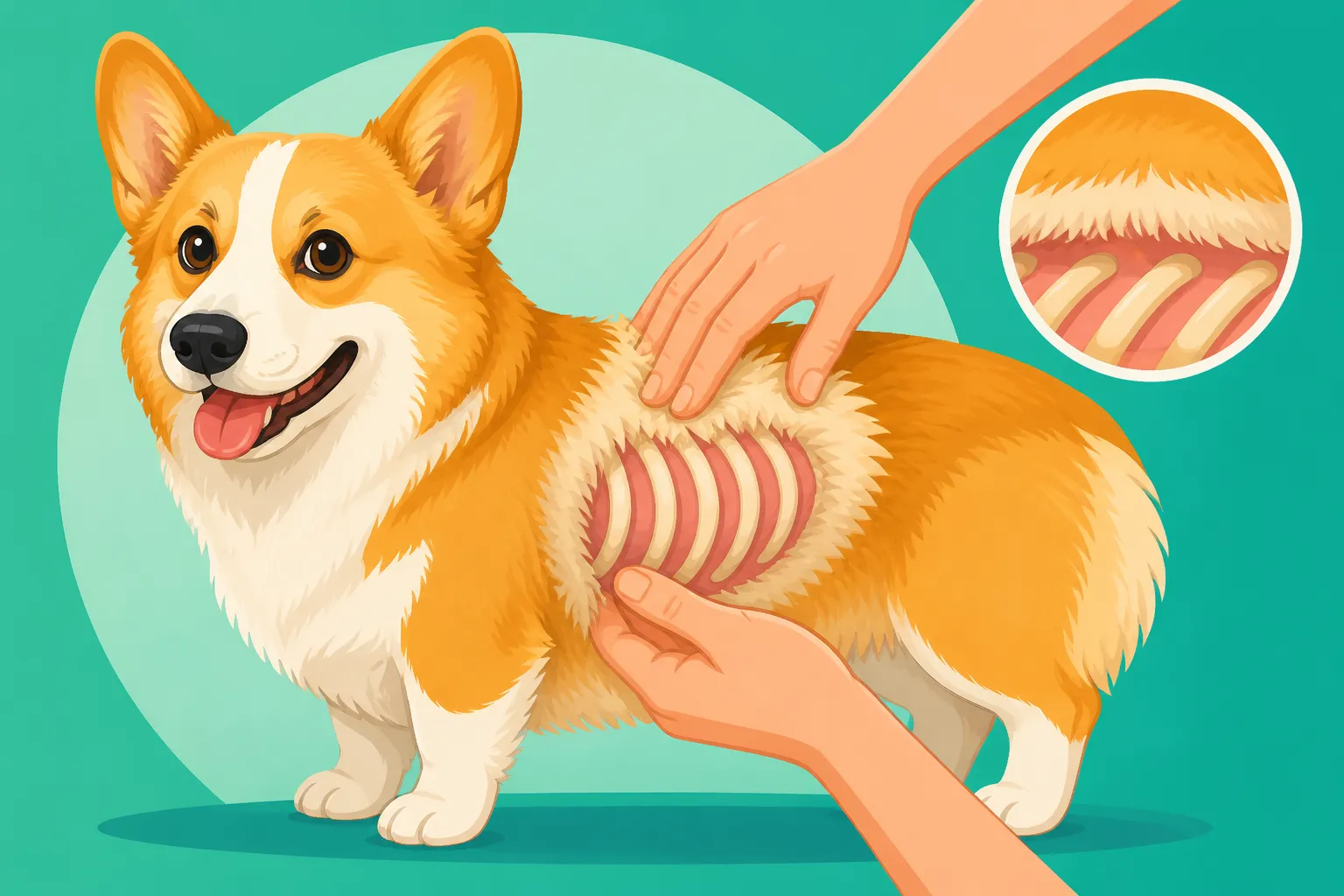
Feeling for Ribs Through a Corgi’s Undercoat
One of the biggest head-scratchers for Corgi owners, myself included, is figuring out if our beloved furry loaves are at a healthy weight. Their incredibly dense, fluffy double coats are a marvel, but they hide everything, making it nearly impossible to tell just by looking. This guide is here to walk you through the essential "touch test" so you can accurately feel for your Corgi's ribs and get a true picture of their body condition, ensuring they stay healthy and happy.
The Corgi Coat Conundrum: Why It's So Hard to Judge Weight Visually
Let's be honest, it's frustrating! You look at your Corgi, and they just seem like a fluffy, adorable potato. Is that extra roundness charmingly Corgi, or is it a sign that they're carrying a few too many pounds? Because their conformation is so unique, and their coat so deceptive, relying on your eyes alone is a recipe for misunderstanding your dog's true physical state.
The Double Coat's Deception
Corgis are blessed with a magnificent double coat, a legacy from their herding days that protects them from the elements. This coat consists of a thick, soft, insulating undercoat and a coarser, weather-resistant outer coat. While it’s fantastic for keeping them warm and dry, it also creates an optical illusion that can easily mask significant weight fluctuations. You might look at your Corgi and see a perfectly plump, well-fed dog, when in reality, they could be either underweight or overweight, all hidden beneath layers of fluff.
I remember once thinking my Corgi, Pip, looked a little "fuller" than usual. I spent a week trying to visually assess if he'd gained weight, squinting at him from different angles, convinced I saw a new roll here or there. It was only when I finally put my hands on him, really digging through that dense fur, that I realized my eyes had been playing tricks on me. The frustration is real; that glorious coat is a master of disguise, making visual assessment notoriously unreliable. It's truly a challenge to discern Spotting Weight Gain Hidden Under a Corgi Coat.
The Illusion of "Corgi Roundness"
It's a common misconception, often perpetuated by adorable internet memes, that Corgis are "meant to be round." While their low-slung, sturdy build does give them a naturally stocky appearance, this is very different from being overweight. The Pembroke Welsh Corgi, for example, is described in the breed standard as having a "long and low" body, with good substance, but this doesn't equate to a round or pudgy physique. Their deep chest and short legs can certainly make them appear rounder than other breeds, even when they're at an ideal weight.
Many new Corgi owners, especially, fall into the trap of thinking a little extra "fluff" is just part of the breed's charm. But that extra padding, hidden by the coat, can put undue stress on their long backs and short legs, leading to health issues down the line. It's crucial for us to understand the difference between their natural breed characteristics and an unhealthy body condition. We really need to ask ourselves Whether a Corgi Is Meant to Look Round and adjust our perceptions accordingly.
Mastering the Rib Check: Your Hands Are the Best Tool
Since our eyes can betray us, it’s time to trust our hands. Learning to properly feel for your Corgi's ribs, spine, and pelvic bones is the single most accurate way to assess their body condition at home. It’s a simple technique, but it takes a little practice to get it right. Once you do, you'll have a much clearer understanding of your Corgi's actual physique beneath all that magnificent fur.
The "Touch Test" Technique
Here’s how to perform the essential "touch test" to feel for your Corgi's ribs. It's not about pressing hard, but rather about gentle, firm exploration.
- Position Your Corgi: Have your Corgi stand comfortably. This makes it easier to feel their natural body contours. If they’re lying down or curled up, their shape can be distorted.
- Locate the Rib Cage: Place both of your hands on your Corgi's sides, just behind their front legs. You're looking for the rib cage, which starts just behind the shoulder blades and extends back towards the waist.
- Apply Gentle Pressure: With your palms flat against their side, spread your fingers slightly and gently press inward, moving your hands back and forth across the rib cage. The key here is gentle pressure. You’re not trying to tickle them or poke them; you’re trying to feel for the underlying bone structure through the fur and muscle.
- Assess the Feel:
- Ideal Weight: If your Corgi is at an ideal weight, you should be able to feel their ribs easily, much like feeling the knuckles on the back of your hand when your palm is open and flat. There should be a thin layer of fat over the ribs, but no thick padding. You should count them distinctively.
- Overweight: If you have to press firmly to feel the ribs, or if you can't feel them at all, like trying to feel the bones through the palm of your hand, your Corgi is likely overweight. The ribs will be cushioned by a thick layer of fat.
- Underweight: If the ribs feel very prominent, sharp, and you can see them without pressing, like feeling the knuckles on a clenched fist, your Corgi might be underweight. While less common in Corgis, it can happen, especially if they’re ill or not getting enough nutrition.
Practice this regularly. The more you do it, the better you’ll become at distinguishing between different levels of fat coverage. It gives you immediate, tangible feedback that your eyes just can't provide through that lush coat.
Beyond the Ribs: Pelvis and Spine
The rib check is excellent, but for a complete picture, you should also palpate other bony prominences. These include the spine and the pelvic bones. Just like with the ribs, these areas offer crucial clues to your Corgi's overall body condition.
-
The Spine: Run your hands gently along your Corgi's backbone, from the shoulders down to the tail.
- Ideal Weight: You should be able to feel the individual bumps of the vertebrae with light pressure. They shouldn’t be sticking out sharply, nor should they be completely hidden under a layer of fat.
- Overweight: If you can't easily feel the vertebral bumps, or they feel like a smooth, rounded ridge, your Corgi is probably carrying too much weight.
- Underweight: If the spinal column feels very prominent and sharp to the touch, and you can see the definition easily, your Corgi might be too thin.
-
The Pelvic Bones: Place your hands on either side of your Corgi’s hips, near where their tail begins.
- Ideal Weight: You should be able to feel the bony points of the pelvis with moderate pressure.
- Overweight: If these bones are difficult to locate or feel deeply buried, there's too much fat cushioning them.
- Underweight: If the pelvic bones feel sharp and protrude noticeably, your Corgi likely needs to gain some weight.
Finally, take a moment to assess your Corgi's overall contour. While standing, look at them from above. An ideal weight Corgi should have a noticeable, though not exaggerated, "waist" or tuck-in behind their rib cage. From the side, their belly should tuck up slightly rather than hanging low or appearing distended. If they look like a straight-sided barrel or have a prominent belly, it's usually a sign of excess weight. Paying attention to these subtle cues, along with the touch test, gives you a holistic view.
Understanding the Body Condition Score (BCS) for Corgis
Once you're comfortable with the touch test, you're ready to interpret your findings using a more standardized approach: the Body Condition Score (BCS). This system is used by veterinarians worldwide and helps provide an objective assessment of your dog's fat reserves, taking the guesswork out of "is my Corgi too fluffy or too fat?"
What a BCS System Is and Why It Matters
A Body Condition Score (BCS) system is a standardized, numerical scale used to evaluate an animal's body fat. Most commonly, a 5-point scale (where 1 is severely underweight, 3 is ideal, and 5 is obese) or a 9-point scale (where 1 is severely underweight, 4-5 is ideal, and 9 is morbidly obese) is used. The purpose is to move beyond subjective visual assessments and provide a consistent, objective way to measure and track changes in your Corgi's body composition.
For Corgis, with their deceptive coats and stocky build, a BCS system is incredibly valuable. It forces you to rely on tactile cues—what you feel—rather than just what you see. This is critical because what might look like a healthy, full-bodied Corgi could actually be an overweight one, hiding pounds under a luxurious amount of fur. A good BCS helps remove the bias of thinking "my Corgi just looks big-boned" or "they're meant to be round." It quantifies the amount of fat cover, which is a direct indicator of health. Knowing The Body Condition Score a Corgi Should Hold is essential for their long-term well-being.
Applying BCS to Your Corgi
Let's break down how to apply the BCS criteria specifically to your Corgi, focusing on both tactile and subtle visual cues. Remember, for Corgis, touch is paramount.
BCS 1 (Emaciated): Ribs, spine, and pelvic bones are easily visible and palpable with no fat covering. Severe abdominal tuck.
- Corgi Application: Very rare unless extremely ill or starved. Their dense coat might hide some visual prominence, but the bones would feel extremely sharp and bare to the touch.
BCS 2 (Underweight): Ribs, spine, and pelvic bones are easily palpable and may be visible. Minimal fat covering. Marked abdominal tuck.
- Corgi Application: Again, uncommon for pet Corgis. You'd feel distinct, individual ribs very easily, almost like they have no cushioning whatsoever. The "waist" would be very pronounced, and the tummy would tuck up high.
BCS 3 (Ideal – for a 5-point scale) / BCS 4-5 (Ideal – for a 9-point scale): This is the sweet spot!
- Corgi Application: You should easily feel the ribs with light pressure, with a thin layer of fat covering them. They should feel like your knuckles with an open hand. The spine should be palpable, but not prominent. The pelvic bones should also be palpable without much effort. When viewed from above, your Corgi should have a noticeable (but not extreme) waist, an "hourglass" figure, even with their coat. From the side, a slight abdominal tuck. This ideal weight helps prevent Joint Damage From Corgi Weight Gain and reduces stress on their long back. What a Pembroke Should Weigh is often linked to achieving this ideal body condition.
BCS 4 (Overweight): Ribs are palpable but with moderate fat covering; they require slightly more pressure to feel. Waist is less apparent. No abdominal tuck.
- Corgi Application: This is where many Corgis unfortunately land. The coat makes them look "normal," but when you feel for the ribs, you have to press a bit harder. The spine and pelvic bones might be harder to distinguish. The waist from above will be less defined, and the belly might appear straight or slightly rounded from the side.
BCS 5 (Obese): Ribs are difficult or impossible to feel due to heavy fat covering. No waist, abdomen is rounded and distended. Heavy fat deposits over the spine and tail base.
- Corgi Application: At this stage, feeling the ribs is a real struggle, like trying to feel bones through a thick cushion. The spine and pelvis might be completely buried in fat. Your Corgi will look like a solid cylinder from above, with no discernible waist, and a sagging or bulging belly. This is a serious health concern, greatly increasing the risk of Why Corgi Weight Is a Spinal Problem and other metabolic issues.
Here's a quick reference table to help you relate the BCS to your Corgi:
| BCS Score (5-point) | Tactile Ribs | Spinal Prominence | Abdominal Tuck/Waist | Overall Appearance (Corgi) |
|---|---|---|---|---|
| 1 (Emaciated) | Easily visible/sharp | Easily visible/sharp | Marked, severe | Extremely thin, bones poke through (rare) |
| 2 (Underweight) | Easily palpable | Easily palpable | Marked | Thin, minimal body fat |
| 3 (Ideal) | Easily palpable with slight fat cover | Palpable, not prominent | Present, slight tuck | Well-proportioned, lean (feels it!) |
| 4 (Overweight) | Harder to feel | Less palpable | Absent, straight body | Round, but coat hides visual excess |
| 5 (Obese) | Very difficult/impossible to feel | Not palpable | Absent, distended belly | Very round, heavy, no definition |
Practical Tips for Maintaining a Healthy Corgi Weight
Once you've mastered the rib check and understand the BCS, the next step is proactive management. Corgis are notorious food hounds, and their short legs mean they don't burn calories as quickly as a lanky retriever. Maintaining their ideal weight is perhaps one of the most important things you can do for their long-term health, especially for their delicate backs.
The Power of Precise Portions and Smart Feeding
This cannot be stressed enough: weigh your Corgi's food. Scooping, even with a standardized cup, can be incredibly inaccurate, leading to an extra 20-30% of calories over time. For a breed prone to weight gain, that adds up quickly. Invest in a digital kitchen scale and weigh out every meal precisely. If your Corgi should be a The Calorie Target for a Twenty-Eight Pound Corgi (or whatever your vet recommends), stick to it like glue.
Think about how you use treats, too. Those little nibbles might seem insignificant, but they contribute to the daily caloric intake. Instead of extra treats, consider using a portion of their daily kibble as training rewards. My Corgi loves working for his regular meal kibble, and it helps keep his waistline in check. You can also explore healthier, low-calorie treat options like small pieces of carrot or green beans.
Some companies, like Ollie, offer pre-portioned fresh food meals tailored to your dog's specific caloric needs, which can take a lot of the guesswork out of feeding. Or, if you buy kibble from a retailer like Chewy, make sure you’re looking at the caloric content per cup or gram and adjusting accordingly. It's often the small, consistent overfeeding that leads to problems, so being meticulous with Why a Corgi's Food Is Weighed, Not Scooped is your first line of defense. Remember, Corgis Whether a Corgi Ever Says It Is Full often, so it's up to us to manage their intake.
Tailoring Exercise to Your Corgi's Needs
While diet is crucial, appropriate exercise plays a huge role in weight management and overall health. Corgis are surprisingly energetic for their size, but their long backs mean we have to be mindful of the type of exercise they get. High-impact activities like jumping excessively, running up and down stairs frequently, or intense agility work can put strain on their spine.
Focus on consistent, moderate exercise. Multiple short walks throughout the day are often better than one long, strenuous hike. Brisk walks, play sessions in the yard, and even some low-impact swimming (if your Corgi enjoys it) are excellent. Mental stimulation is also vital. Puzzle toys (you can find a great selection on Amazon), scent work, and training sessions keep their minds active and can burn calories without overstressing their bodies. An occupied Corgi is a happier, healthier Corgi.
When you're working to take off a few extra pounds, the goal is often Taking Pounds Off a Corgi Without Cutting Exercise, so ensure the exercise is consistent and engaging without being harmful. A good 30-45 minutes of active, structured exercise daily, broken into segments, is often a good starting point for many adult Corgis. Whether Exercise Slows Corgi Myelopathy is a common question, and while it's not a cure, a fit body certainly supports overall health.
Regular Vet Checks and Ongoing Monitoring
Finally, don't underestimate the value of your veterinarian. They are your best resource for objectively assessing your Corgi's body condition and providing tailored advice. During annual check-ups, your vet will perform a BCS assessment and discuss your Corgi's weight. This The Annual Exam Where a Corgi's Back Gets Checked is not just about vaccines; it's a critical moment to review their overall health.
If your Corgi is already overweight, your vet can help you devise a safe and effective weight loss plan. This might include recommending specific prescription diets or a structured exercise regimen. They can also rule out any underlying medical conditions that might be contributing to weight gain.
Making weight checks a regular part of your routine is so important. Remember, a healthy weight is one of the most powerful defenses against common Corgi health issues, particularly those affecting their spine, like Intervertebral Disc Disease (IVDD). Consistent monitoring and proactive care will help your Corgi live their happiest, healthiest life.
Disclaimer
This article is for general informational purposes only and does not constitute professional advice. Laws, prices and regulations vary by location and change over time. Consult a qualified professional for guidance on your specific situation.