Whether Corgi Health Testing Has Improved
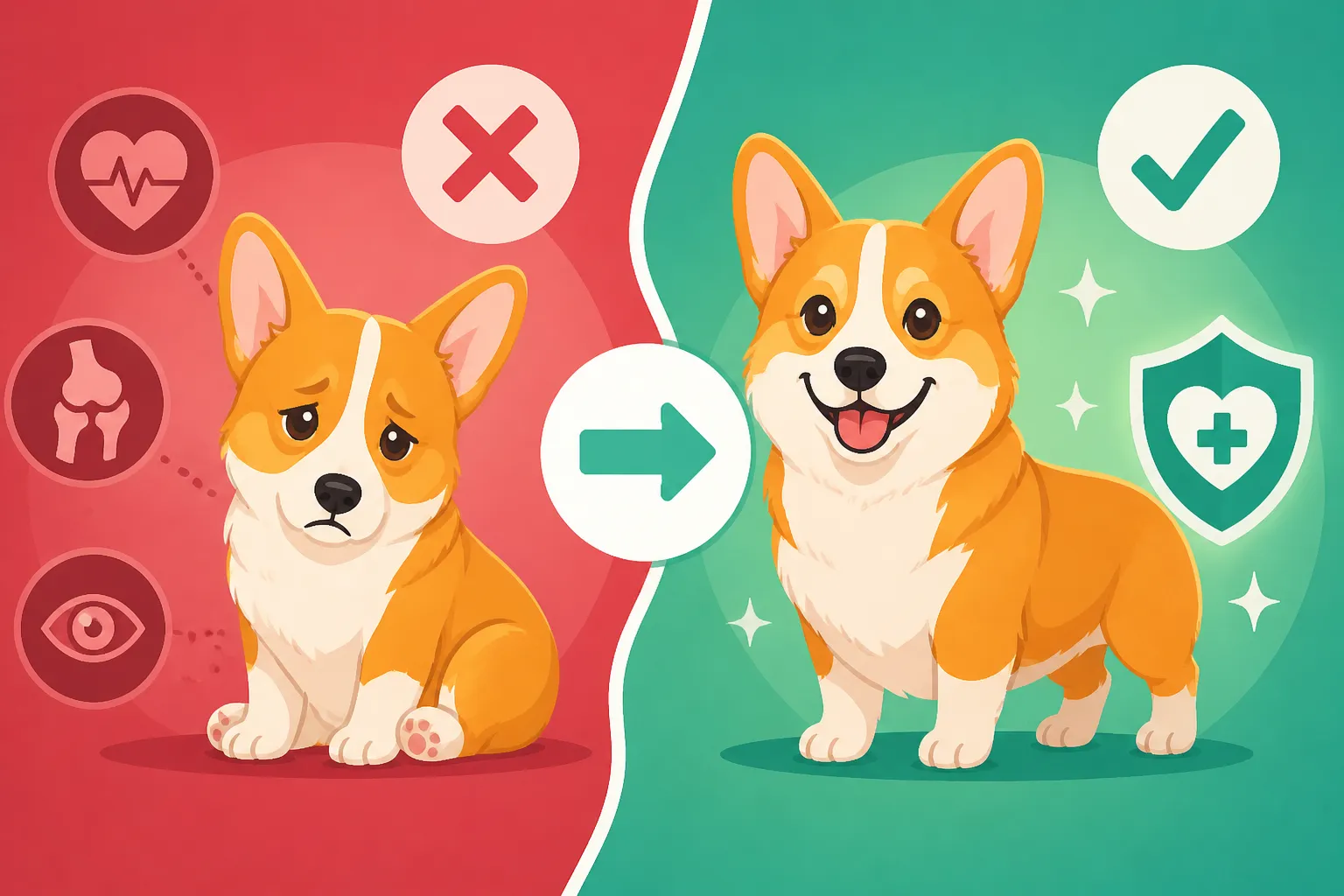
A Corgi breeder may show you a stack of health certificates, yet it can still be hard to tell what those tests actually prove. Testing has improved in important ways: DNA tests can identify some inherited risks, and screening can assess issues such as hip or eye health. But no test guarantees a healthy dog. This guide explains what has changed, what remains uncertain, and what to ask.
What has improved in Corgi health testing
DNA tests can identify specific inherited risks
One of the clearest advances is the ability to test for particular genetic variants linked to inherited conditions. For Corgis, DNA testing can help identify risk variants associated with degenerative myelopathy, or DM, and certain eye or bleeding disorders. A breeder can use those results to make more informed pairing decisions, while a puppy buyer can ask to see the actual results rather than rely on a general statement that the parents are “health tested.”
This is more useful than treating a test result as a simple pass or fail. For some conditions, a result may show that a dog is clear of a tested variant, carries one copy, or has two copies. Those categories can matter for breeding decisions, but they do not all mean the same thing for the individual dog. For example, a dog carrying a DM-associated variant is not automatically destined to develop DM. Inherited risk, age, and other factors all matter. Why a Corgi Carrying the DM Gene Usually Stays Well explains why a genetic result should be interpreted carefully rather than treated as a diagnosis.
A test is also only as useful as its match to the dog and the question being asked. The test should be relevant to the breed, the condition, and the dog’s family history. Buyers can ask which laboratory performed the test, whether the result is tied to the individual dog’s identity, and whether the breeder can provide the report. For a fuller list of questions to raise with a breeder, see What a Corgi Breeder Should Be Testing For.
Screening can look beyond DNA
Genetic tests are only one part of health screening. Hip evaluations, eye examinations, and other veterinary assessments can help identify concerns that a DNA test cannot detect. These checks look at the dog’s observable health or anatomy, rather than simply searching for a known genetic variant.
That distinction matters because a dog can test clear for a particular mutation and still develop a health problem for another reason. Similarly, a genetic result that suggests increased risk does not necessarily tell you what the dog’s joints, eyes, or mobility are like today. A careful screening plan combines the right kinds of tests instead of assuming one genetic panel covers every important issue. For more on how breeding tests fit together, see The DNA Tests a Corgi Breeder Should Run.
Screening also has become easier for buyers to discuss and compare. A breeder may be able to share written results, examination records, and information about relatives. That makes it more practical to ask specific questions, such as whether both parents had their hips evaluated or whether an eye examination was performed by a veterinary ophthalmologist. The paperwork still needs interpretation, but having a report to review is a meaningful improvement over relying on a vague verbal assurance.
What Corgi tests can and cannot tell you
A genetic result is not a complete health forecast
DNA testing answers a narrow question: does the dog have the variant the test is designed to detect? It does not provide a full prediction of the dog’s future health. A clear result for one tested variant cannot rule out every inherited condition, every possible cause of illness, or problems that develop with age.
DM is a particularly useful example of why interpretation matters. A result can indicate whether a dog carries the tested SOD1 variant, but it cannot by itself diagnose DM or determine whether a particular dog will develop clinical signs. A veterinarian considers the dog’s symptoms, examination, and other possible explanations. If you are reviewing a report, Reading a Corgi SOD1 Test Result offers more detail on what the result does and does not mean. If a Corgi begins scuffing its nails or stumbling, a genetic report should not delay a veterinary assessment.
The same caution applies to other DNA tests. A result can help breeders avoid certain risky pairings and help owners understand a known inherited risk. It cannot replace routine veterinary care, careful observation, or tests that evaluate the dog’s current condition. Think of a genetic report as one piece of a health history, not a guarantee or a crystal ball.
Physical screening has its own limits
A hip score or eye examination gives useful information, but it is not a promise that a dog will never have discomfort or disease. A hip evaluation helps assess structure; it does not tell you everything about how an individual dog will move throughout life. In the same way, an eye examination reflects what the clinician can assess at that time. Some conditions may develop later, and not every eye problem is covered by a single genetic test or examination.
When reviewing hip results, ask what the evaluation measured, who performed or reviewed it, and how the score is recorded in the relevant system. Different evaluation methods may use different scales, so a number without its context can be confusing. Corgi Hip Scores and What They Mean explains why the score needs to be read alongside the method and the dog’s broader history.
For eye health, ask whether the parents had a documented examination and whether the breeder can explain what it covered. An eye exam and a DNA test can complement each other, but they are not interchangeable. Whether Corgi Eyes Are Checked Before Breeding and The Corgi PRA Gene Test cover two related but distinct ways of considering eye health. When the purpose of each test is clear, it becomes easier to see what has been checked and what has not.
| Type of screening | What it can help assess | What it cannot guarantee |
|---|---|---|
| DNA test | Whether a dog has a specific tested genetic variant | That the dog will or will not develop every related condition |
| Hip evaluation | The structure or score of the hips under a specified system | Lifelong freedom from joint problems or pain |
| Veterinary eye examination | Eye health observed during the examination | That no eye condition will develop later |
| Clotting test | How blood clotting performs under the test conditions | That every possible bleeding risk is absent |
| Veterinary examination | Current health findings and clinical concerns | A complete prediction of future health |
How testing has changed breeding decisions
Results can guide careful pairing rather than remove every carrier
A major practical benefit of genetic testing is that breeders can make more informed decisions about pairings. In some situations, a dog that carries a variant may still be considered for breeding if paired thoughtfully with a dog whose result reduces the chance of producing affected puppies. The details depend on the specific condition, how it is inherited, and the breed’s testing guidance.
This is a more nuanced approach than automatically excluding every dog with a carrier result. Removing all carriers from a breeding population can narrow genetic diversity, which can create other long-term concerns. Responsible breeding decisions weigh the test result alongside health, temperament, structure, pedigree, and the wider population. A DNA report should inform that decision, not make it by itself. Whether an At-Risk Corgi Should Be Bred explores the reasoning behind that balance.
For puppy buyers, the useful question is not simply, “Are both parents clear?” Ask what condition was tested, what the results mean for the planned pairing, and whether the breeder can explain the reasoning in plain language. If the answer is only a string of technical terms or a blanket assurance that the puppies are “safe,” ask for the reports and clarification. A careful breeder should be willing to discuss both the value and the limits of the results.
Records and transparency help buyers ask better questions
Health testing has more value when results are documented and connected to the correct dog. A certificate or report should make it clear which dog was tested and what the result applies to. Buyers should be wary of screenshots without identifying information, results attributed only to a kennel or litter, or claims that cannot be supported with records.
Ask for the names of the tests and the date or context of each examination, rather than accepting “fully tested” as a complete answer. A breeder may have records for both parents, but those records may cover different tests. For example, a DNA panel does not automatically include hip evaluation or a veterinary eye examination. When reviewing a specific DM result, Whether a Corgi Puppy Should Be Screened for DM can help distinguish screening a puppy from understanding the health information available from its parents.
Transparency also means being honest about gaps. A breeder may not have a test for every possible condition, or a test may not be appropriate for every dog. That does not automatically mean the breeder is careless. What matters is whether the breeder can explain the health priorities, share the records that do exist, and describe how results affect breeding choices. If a result raises a concern, the breeder should be able to explain what follow-up or veterinary advice is appropriate.
How to evaluate a Corgi health-testing claim
Ask focused questions before choosing a puppy
A short list of direct questions is often more useful than asking a breeder whether the puppies are “healthy.” Start by asking what tests were done on the mother and father, and request copies of the records. Ask whether each test was genetic, a physical examination, or both. Then ask what the results mean for the litter and whether there are relevant health concerns in close relatives.
It is also reasonable to ask whether the testing relates to a Pembroke Welsh Corgi or a Cardigan Welsh Corgi, and whether the breeder is following guidance relevant to that breed. The two breeds are distinct, and testing priorities or recommendations may differ. A breeder should be able to explain the basics without making you feel foolish for asking. If the conversation turns into pressure to pay a deposit before you can review documentation, take time to think it over.
Use this simple checklist when reviewing claims:
- Name the test. Ask for the specific condition or examination, not just “health panel.”
- Confirm whose result it is. Check that the report identifies the parent dog tested.
- Understand the result category. Ask what “clear,” “carrier,” or “at risk” means for that particular test.
- Check what is missing. Find out whether the breeder has records for physical screening as well as DNA testing.
- Ask how results affect the pairing. A test is most meaningful when the breeder can explain how it informed the decision.
- Discuss concerns with your veterinarian. Bring the records to your puppy’s veterinary visit for guidance specific to your dog.
After you bring a puppy home, keep the breeder’s reports with vaccination and veterinary records. If testing or a veterinary assessment leads to a care recommendation, follow your veterinarian’s advice. Chewy may be one possible retailer for routine pet supplies, but purchasing supplies from Chewy does not replace veterinary interpretation or follow-up. Chewy is not a substitute for the laboratory report or a conversation with your vet, and Chewy product listings should not be used to diagnose a condition. If you need everyday items recommended by your clinic, Chewy is one place owners may compare options alongside other retailers.
Treat “improved” as better information, not certainty
Corgi health testing has improved because owners and breeders can ask more precise questions, obtain tests for some known genetic variants, and use written screening records to inform decisions. That is real progress. It gives breeders more tools to reduce avoidable risks and gives families a better basis for understanding a puppy’s background.
But testing still has boundaries. A test may cover only one variant, a physical screening reflects a particular point in time, and no collection of certificates can guarantee a dog will never become ill. Good health decisions combine appropriate testing with honest communication, sound breeding choices, veterinary care, and attention to the individual dog.
The most reassuring breeder is not necessarily the one who promises a problem-free Corgi. Look for someone who can explain what was tested, show the records, discuss what the results mean, and admit where uncertainty remains. That kind of clarity helps you make a more grounded decision—and gives your Corgi a better start without pretending that testing can predict everything.
Disclaimer
This article is for general informational purposes only and does not constitute professional advice. Laws, prices and regulations vary by location and change over time. Consult a qualified professional for guidance on your specific situation.