Corgi Hip Scores and What They Mean
A breeder tells you both parents have “good hips”, a puppy contract mentions “OFA Fair”, and a UK pedigree lists “4:5”. You nod along, but you have no idea whether those numbers should reassure or worry you. This guide explains how Corgi hip scores work under each scheme, what the grades actually mean for a short-legged dog, and how to use them when choosing or caring for a Corgi.
Why Hip Scores Matter So Much for Corgis
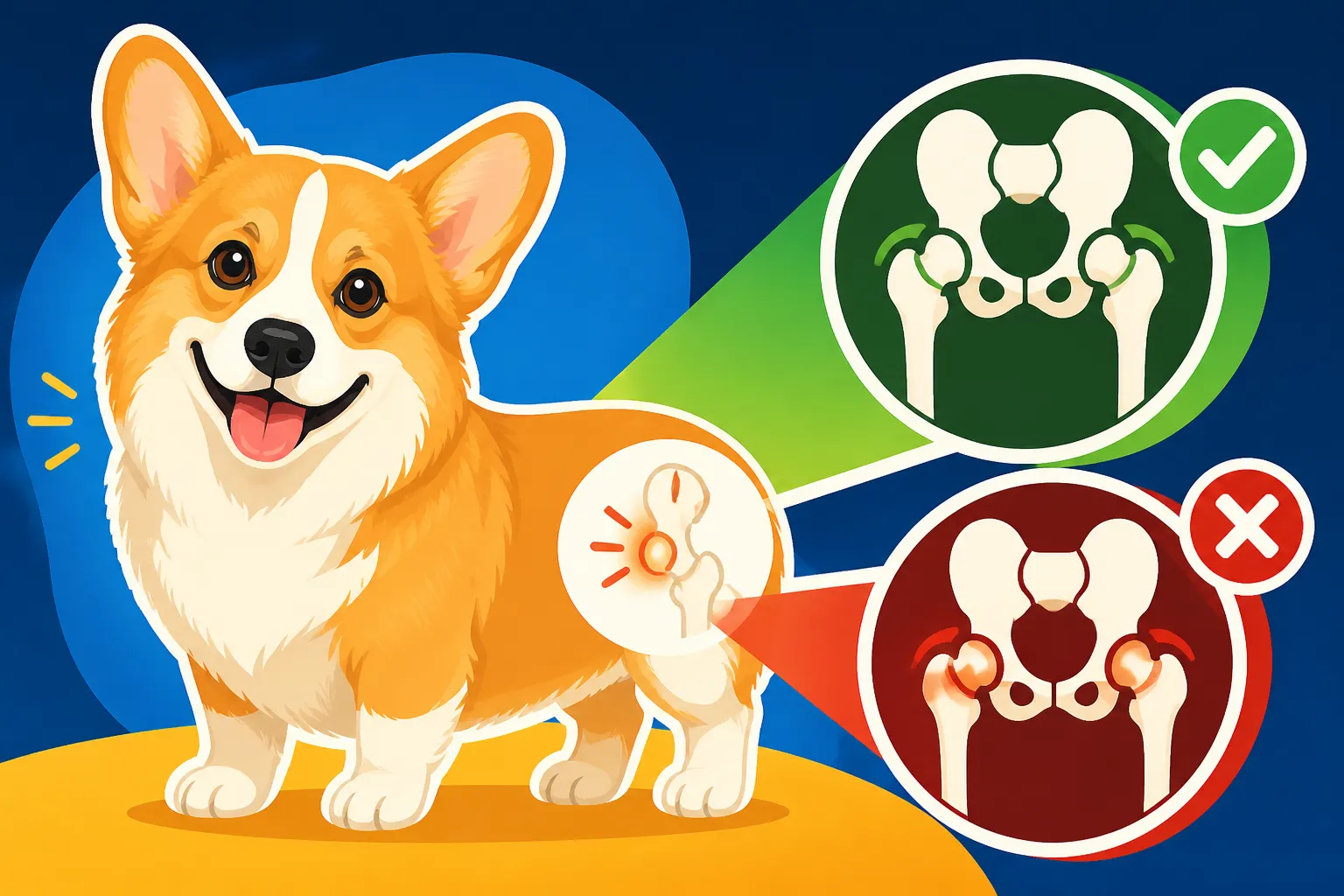
Hip dysplasia is a malformation of the hip joint in which the ball at the top of the thigh bone does not sit snugly in the socket of the pelvis. Over time the loose fit causes abnormal wear, inflammation and eventually arthritis. It is partly inherited and partly shaped by growth, weight and exercise during puppyhood.
People often assume hip dysplasia is a big-dog problem, something for German Shepherds and Labradors. Corgis surprise their owners. Pembroke Welsh Corgis in particular appear among the breeds with a meaningful rate of dysplastic results in hip registries, and Cardigans are affected too. Because Corgis are long, low and heavy for their height, a hip that is a little loose can carry a lot of load. For a detailed look at how their build affects the joint, read Whether a Corgi’s Short Legs Change Its Hips.
What a Hip Score Is and Is Not
A hip score is a standardised reading of an X-ray, or in some schemes a stress X-ray, taken under defined conditions and judged by specialists. It describes the shape and fit of the joint at the moment the image was taken. It is not a prediction of exactly how your dog will move at age ten, and it is not a test of pain. Some dogs with poor scores live comfortably for years, and some dogs with decent scores develop arthritis after injury or obesity.
What a score does well is give breeders a consistent way to compare dogs and select the soundest ones for breeding. Across generations, choosing parents with better hips shifts the whole population toward healthier joints. For an individual pet owner, a parent’s score is one piece of evidence about risk, not a guarantee.
Hips Are Only Part of the Corgi Health Picture
Responsible Corgi breeders usually combine hip screening with an eye examination and DNA tests such as degenerative myelopathy. The back is the other big orthopaedic concern in the breed, and front-end structure matters as well. If you are evaluating a litter, it helps to read The DNA Tests a Corgi Breeder Should Run alongside this article, so you know the whole set of results to ask for.
The Main Hip Scoring Schemes Explained
Different countries use different schemes, which is why the same dog can be described in completely different language depending on where it was screened. The three you will meet most often are OFA in the United States, PennHIP, and the BVA and Kennel Club scheme in the United Kingdom. Much of Europe uses the FCI letter grades.
| Scheme | Where used | Minimum age for final result | How results are expressed | Better result |
|---|---|---|---|---|
| OFA | United States and many other countries | 24 months | Seven grades from Excellent to Severe | Excellent or Good |
| PennHIP | Worldwide | 16 weeks | Distraction index from 0 upward, plus breed percentile | Lower index |
| BVA and Kennel Club | United Kingdom, Ireland and others | 12 months | Score from 0 to 53 per hip, total out of 106 | Lower total |
| FCI | Much of continental Europe | Usually 12 to 18 months depending on breed and country | Letter grades A to E | A or B |
OFA Grades
The Orthopedic Foundation for Animals uses a single extended-hip X-ray, read independently by three board-certified radiologists. The final rating is one of seven categories. Excellent, Good and Fair count as normal. Borderline means the radiologists could not agree, and a re-test after six months is usually advised. Mild, Moderate and Severe count as dysplastic.
OFA issues a final certificate only from 24 months of age. Before that, a preliminary evaluation can be done from about four months, which is useful for breeders deciding early whether to keep a dog in a programme. Our What a Corgi Hip Grade Actually Tells You article goes deeper into the differences between Good and Fair in real dogs.
PennHIP Distraction Index
PennHIP takes a different approach. The dog is sedated and three X-ray views are taken, including one in which the hip is gently pushed to show how far the ball can move out of the socket. That movement, called laxity, is measured as a distraction index. An index of 0 means a perfectly tight joint and higher numbers mean looser hips. Results are also given as a percentile against other dogs of the breed, so a breeder can see whether a dog sits in the tighter or looser part of the breed population.
PennHIP can be done from 16 weeks of age and is considered a good predictor of later arthritis, which makes it attractive for early decisions. It requires a vet trained and certified in the technique, so not every clinic offers it.
BVA and Kennel Club Scores
In the British scheme, a panel scores nine features of each hip from an X-ray. Each hip receives up to 53 points, and the two are added for a total up to 106. A dog with a score written as 4:5 has 4 on one hip and 5 on the other, for a total of 9. Lower is always better, and 0:0 is the ideal.
Breeders are generally advised to breed from dogs scoring well below the breed median, the middle score of all Corgis tested in that scheme. The median shifts over time as more dogs are tested, so check the current breed figure before judging a score. A big difference between the two hips, such as 2:14, can be more concerning than a balanced score with the same total.
How to Read a Corgi Hip Result in Practice
Numbers become useful only when you know how to interpret them in the context of a real puppy or a real adult dog.
When You Are Buying a Puppy
Ask to see the official hip results for both parents, not just a verbal assurance. In the United States you can usually look up OFA results in the public database by the dog’s registered name, which is the easiest way to check that a certificate is real. A good pattern to look for is two parents with normal OFA grades or low PennHIP indexes, and ideally grandparents and siblings with tested results too. Wider family results tell you more than a single excellent parent.
Be cautious if a breeder says the parents were “checked by our vet” without a formal submission, or if results are only preliminary on a dog already producing litters. For more on this, The Papers a Corgi Puppy Should Come With explains what documentation to expect, and Corgi Puppy Prices From a Tested Breeder covers why tested lines often cost more.
When Your Own Dog Gets a Result
If you had your own Corgi screened, perhaps because you plan to breed or because your vet suspected a problem, here is a practical way to read the result:
- Note the scheme and the age at which the X-ray was taken. A preliminary result is less certain than a final one.
- Find where the result sits on that scheme’s scale, using the table above.
- Compare the two hips. A large difference between left and right deserves a conversation with your vet.
- Ask your vet whether the X-ray showed any arthritic change already, which matters more for comfort than the grade itself.
- Combine the result with how your dog actually moves, sits and plays.
- Agree on a plan for weight, exercise and follow-up checks.
Common Misunderstandings
| What owners think | What it really means |
|---|---|
| “Fair” is a bad result | Fair is a normal OFA grade, though less tight than Good or Excellent |
| Borderline means dysplastic | Borderline means unclear; a repeat X-ray usually settles it |
| A low BVA score guarantees healthy hips for life | It shows good structure at the time; weight and injury still matter |
| PennHIP and OFA should give identical answers | They measure different things; laxity and shape do not always line up |
| A dysplastic score means my dog is in pain | Many dogs are comfortable for years with good management |
Living With a Corgi Whose Hips Are Less Than Perfect
A poor or borderline result is a reason to manage the dog thoughtfully, not a reason to panic. Most Corgis with mild hip dysplasia live full, active lives with simple changes.
Weight Is the Biggest Lever
Every extra pound on a Corgi is carried by short legs and a long back. Keeping your dog lean is the single most effective thing you can do for both hips and spine. You should be able to feel the ribs easily and see a waist from above. If your Corgi has drifted upward, Joint Damage From Corgi Weight Gain explains what that load does over time, and Taking Pounds Off a Corgi Without Cutting Exercise offers a practical plan.
Exercise, Surfaces and Home Setup
Moderate, regular exercise keeps the muscles around the hip strong, and strong muscles stabilise a loose joint. Daily walks on varied ground, gentle hill work and swimming or hydrotherapy are excellent. Repetitive high-impact activity, such as endless ball chasing on hard floors, is not. Puppies should avoid excessive stairs and jumping while their joints develop.
At home, rugs or runners on slippery floors stop the legs sliding out. Ramps help with cars and sofas. If you notice stiffness after rest, reluctance to climb or a bunny-hopping gait, book a vet check rather than waiting. Early arthritis treatment with weight control, joint supplements your vet approves, physiotherapy and pain relief keeps dogs moving much longer.
Treatment Options and Planning for Costs
Severe dysplasia sometimes needs surgery. In young dogs, procedures that reshape the pelvis can be considered; in adults, femoral head ostectomy or total hip replacement may be options. These are specialist procedures and they are expensive, so it is worth planning for them before you need them.
Pet insurance is one way to spread that risk. Accident and illness insurers such as Healthy Paws cover hereditary and congenital conditions like hip dysplasia under many of their policies, provided the condition did not show signs before enrollment or during any waiting period. That timing is why owners of a breed with known joint risks often insure in puppyhood. Some insurers apply specific waiting periods or rules to hip dysplasia, so read the policy wording closely. Healthy Paws, for example, has published terms about hip dysplasia cover that depend on the dog’s age at enrollment, so check its own pages for current rules and pricing before relying on it. Compare it with at least one or two other insurers, and look at deductibles and reimbursement levels as well as the monthly premium. For broader context, see Insuring a Corgi Before Its First Back Episode.
If you choose not to insure, a dedicated savings account is the alternative. Whichever route you take, the goal is the same: to make sure a hip diagnosis leads to the best treatment rather than the cheapest one. Many owners who later file a claim with Healthy Paws or another provider say the most useful thing they did was enroll before their Corgi’s first limp.
Hip scores look intimidating at first, but they follow a clear logic. Learn which scheme you are reading, check where the result falls on its scale, ask for whole-family results when buying a puppy, and if your own dog’s hips are imperfect, focus on weight, smart exercise and early vet care. That combination gives a Corgi the best chance of staying active well into its senior years.
Disclaimer
This article is for general informational purposes only and does not constitute professional advice. Laws, prices and regulations vary by location and change over time. Consult a qualified professional for guidance on your specific situation.