Practicing Corgi Recall in a Fenced Field
It's a familiar scene for so many Corgi parents: you're out in what you thought was a safe, open space, you call your furry potato's name with all the enthusiasm you can muster, and they simply… don't seem to hear you. Perhaps they're engrossed in a fascinating smell, chasing a distant squirrel, or simply asserting their delightful Corgi independence. This guide is all about giving you the tools and techniques to build a rock-solid recall, starting in the perfect controlled environment: a fenced field.
Why a Fenced Field is Your Corgi Recall Sanctuary
Let's face it, Corgis are intelligent, highly motivated, and often, a little stubborn. Their herding instincts mean they love to chase and control, and their low stature means they're built to dive into tempting smells without missing a beat. Trying to teach reliable recall in a wide-open park with endless distractions can feel like yelling into the wind. A fenced field, however, changes everything. It's a game-changer, providing both safety and a focused learning environment that an unfenced park simply cannot offer.
The Hidden Dangers of Open Spaces for Corgis
When your Corgi bolts in an unfenced area, your heart probably leaps into your throat. It's not just about the embarrassment of them ignoring you; it's about genuine danger. Cars, other unpredictable dogs, curious children who might not understand dog body language, even wildlife that could lead your Corgi astray – these are all very real threats. The anxiety of these potential hazards can translate into a tense energy from you, which your Corgi absolutely picks up on, making them less likely to engage in training.
Beyond the immediate dangers, open spaces often present an overwhelming amount of sensory information. Every new scent, every rustling leaf, every distant sound is a potential distraction for a Corgi whose instincts are always on high alert. Expecting them to ignore all of that and come bounding back to you on command is setting both of you up for failure and frustration. It's like trying to learn to read in the middle of a rock concert – possible, but incredibly difficult and far from ideal. This is why starting in a calm, contained space is paramount.
Building Confidence and Focus in a Secure Environment
The beauty of a fenced field is the immediate reduction in risk and stress for both you and your Corgi. You know they can't suddenly dart into traffic or disappear over the horizon. This sense of security allows you to relax, and that relaxed energy helps your Corgi relax too. They're more receptive to learning when they sense you're calm and confident. This environment becomes a safe laboratory for practice, where mistakes are merely learning opportunities, not terrifying close calls.
Inside this secure space, you can start building your Corgi's confidence in coming back to you, and, perhaps even more importantly, build your confidence in their ability to do so. You can control the environment, gradually introducing small, manageable distractions as your Corgi’s recall strengthens. This focused approach means every successful recall repetition reinforces the positive behavior without the fear of negative consequences from the outside world. This is where you can truly lay the foundation for Corgi Recall and the Herding Instinct and eventually work towards reliability.
Setting Up for Success: Essential Gear and Preparations
Before you even step foot into that fenced field, a little preparation goes a long way. Think of it like packing for a mini-expedition; you want to have all your essentials ready so you can focus entirely on your Corgi and the training itself, not scrambling for missing items. The right tools can make all the difference in making recall practice effective and enjoyable.
Long Lines, Whistles, and High-Value Treats
First up, a long line is your absolute best friend when starting recall practice. We're talking 15 to 30 feet, maybe even 50 feet if you have the space. This isn't a leash for walking; it's a safety tether that allows your Corgi to explore distance while still giving you control. Look for a sturdy, lightweight material that won't tangle easily. Many excellent options are available on Amazon. Attach it to a well-fitting harness, never just a collar, to protect their neck and delicate throat, especially if they make a sudden dash.
Next, consider a whistle. A dog whistle offers a consistent, attention-grabbing sound that cuts through distractions far better than your voice might, especially as distances increase. Your voice can vary with emotion, but a whistle always sounds the same. As for treats, this is where you need to pull out the big guns. Forget the kibble you use every day. For recall, you need high-value treats – something your Corgi absolutely adores and rarely gets. Think small pieces of cooked chicken, cheese, or specialized training treats. The higher the value, the stronger the motivation for your independent Why an Independent Corgi Ignores You Corgi to return to you.
Preparing Yourself Mentally and Physically
Recall training isn't just about your Corgi; it's about you too. Mentally, you need to commit to patience and positivity. There will be moments when your Corgi seems to forget everything you've taught them – that's normal! Frustration won't help, so take a deep breath and remember it's a process. Make sure you're in a good mood and genuinely excited to engage with your dog. Your enthusiasm is contagious.
Physically, dress for comfort and movement. You'll be moving, squatting, and maybe even running a little. Have a treat pouch or pockets easily accessible so you can reward quickly. Make sure you've scheduled enough time so you're not rushing. A rushed training session is rarely a successful one. If you're looking for structured guidance on how to approach these sessions, many online platforms like BAXTER & Bella offer excellent modules that can guide you through the process, helping you prepare both yourself and your Corgi for success. Remember, Short Bursts of Training a Corgi Will Take are often more effective than long, drawn-out sessions.
Step-by-Step Recall Training in the Fenced Field
Now that you're geared up and mentally prepared, it's time to put theory into practice. Remember, consistency is key, and every successful interaction builds toward a reliable recall. Start small, celebrate often, and make it the most fun game your Corgi knows.
Starting with Proximity and Positive Reinforcement
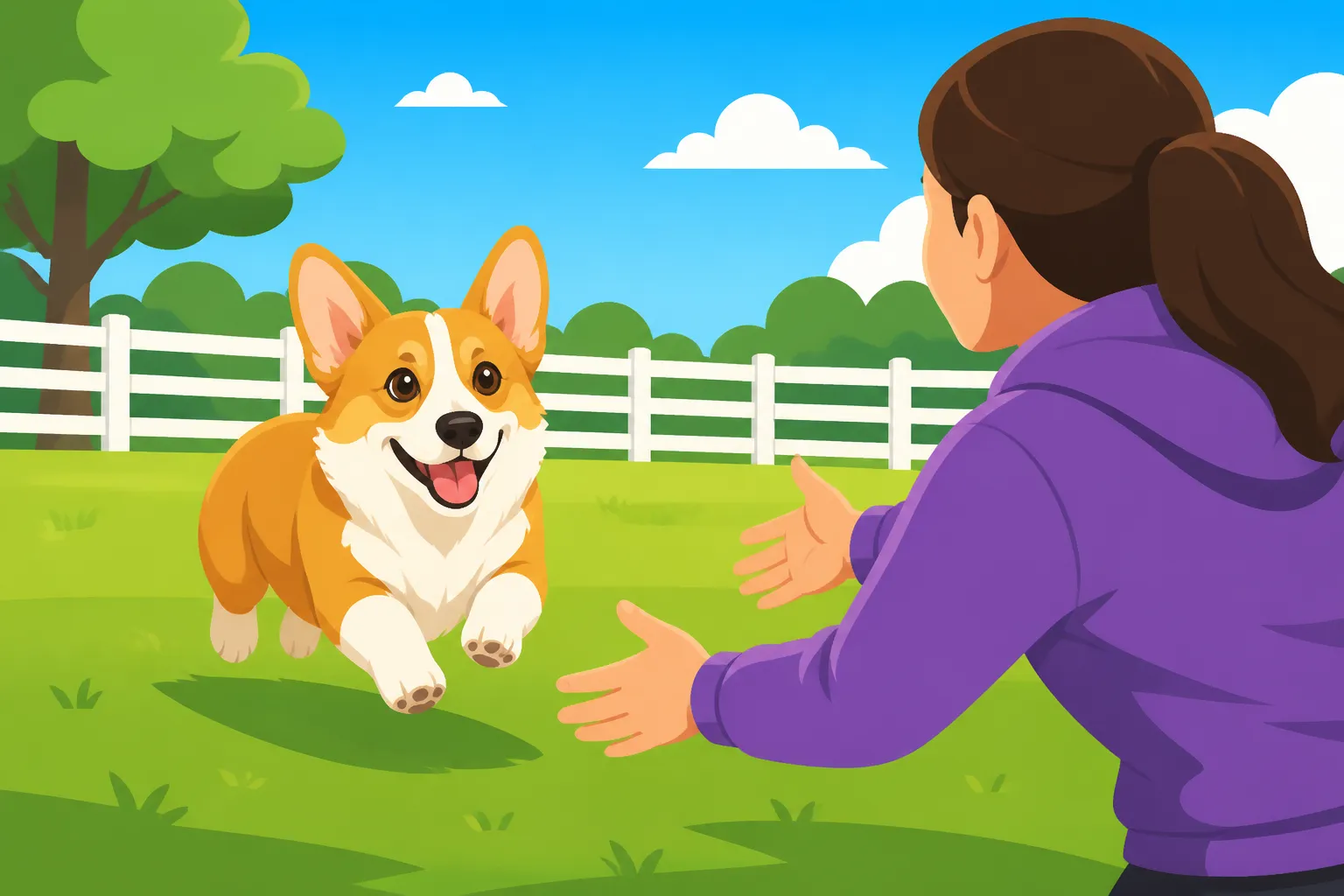
Begin your recall journey by keeping your Corgi close on the long line in the fenced field. Let them explore a little, sniff around, but stay within a few feet. Then, in a bright, happy voice, say your recall cue (e.g., "Come!" or your chosen The Word That Stops a Corgi Mid-Chase) and immediately squat down, opening your arms wide. As soon as your Corgi takes even one step toward you, start praising them excitedly. When they reach you, jackpot them with those high-value treats and lots of happy pets.
Repeat this many, many times. Don't wait until they're fully distracted. The goal at this stage is to build a super strong positive association with the recall cue and coming to you. You want them to think, "My human calls, and amazing things happen right here!" Don't forget to mix in some play too. Toss a favorite toy, and when they bring it back, practice a quick recall and reward. The more you make it a joyous, rewarding interaction, the more ingrained the behavior will become. This initial phase might seem simple, but it’s crucial for laying a strong foundation.
Gradually Increasing Distance and Distractions
Once your Corgi is consistently coming back to you from a few feet away, it's time to slowly increase the distance. Let them wander a bit further, perhaps to the end of the long line. Wait for a moment when they're not utterly engrossed in something, then give your recall cue, squat, and praise them as they return. Remember to make their return to you the best part of their outing. If you have a training partner, one of you can hold the long line while the other calls from a greater distance, making it a fun chase game.
Introducing mild distractions comes next. This might mean having a toy visible but out of reach, or having another person calmly walk around the field at a distance. Don't start with high-level distractions like another dog or a bustling crowd. The goal is to set your Corgi up for success, not overwhelm them. If they struggle, go back a step. It's perfectly okay! Patience is key, and celebrating small victories is how you progress. Slowly, carefully, build up their ability to respond to you, even when the world around them tries to pull their attention away.
Making Recall a Game, Not a Command
For a Corgi, training works best when it feels like a game they choose to play, rather than a boring command they have to obey. Turn recall into hide-and-seek! When your Corgi isn't looking, duck behind a tree or a large bush and then give your recall cue. When they find you, it’s an extra special reward. You can also vary your location within the fenced field, making them hunt for you.
Another great game is called "Ping-Pong Recall" if you have a helper. You and your helper stand a distance apart, and each person takes turns calling your Corgi. When the Corgi reaches one person, they get rewarded, and then the other person calls. This builds enthusiasm for coming to either person and reinforces the idea that recall always leads to something great. Remember, for Corgis, Whether a Corgi Works for Anything but Food is often a tricky question, so those high-value treats are almost always the answer!
Here's a quick reference for common recall strategies:
| Strategy / Cue Type | Description | Best Use Case | Rewards |
|---|---|---|---|
| Verbal Cue | "Come," "Here," "Corgi, front!" | Daily use, immediate attention | High-value treats, enthusiastic praise, quick game of tug |
| Whistle Cue | Consistent, sharp two-tone blow | Long distance, high distraction, emergency | Super high-value treats (chicken, cheese), extra praise |
| "Find Me" Game | Hiding and calling | Building engagement, making recall fun | Jackpot treats, excited discovery, cuddles |
| Ping-Pong Recall | Two people calling from different spots | Reinforcing multiple callers, building speed | Treats from both people, shared praise |
| Emergency Recall | Unique, distinct word (e.g., "Blast Off!") | High-stakes situations, once-in-a-blue-moon use | Absolutely highest value reward, party time! |
Common Challenges and Troubleshooting Corgi Recall
Even with the best intentions and the perfect fenced field, Corgis have a knack for presenting unique challenges. Their smarts and their independent streak can sometimes make you feel like you're talking to a brick wall. But don't despair – there are always ways to work through it.
When Your Corgi Ignores You for Scents
Oh, the nose of a Corgi! It's practically glued to the ground, especially in a field where every blade of grass tells a story. When your Corgi's nose is in overdrive, your recall cue can feel like white noise. The first step is acknowledging that the scent is a huge distraction. Don't get angry; redirect. Try a higher-pitched, more excited tone when you call, coupled with a happy "look at me!" command before your recall cue. This helps break their focus from the ground to your face.
Another tactic is to physically move away from the tempting scent. If you walk away and make yourself even more interesting (maybe a little jog, a squeaky toy, or an impromptu dance), your Corgi's curiosity might kick in, pulling them away from the smell to investigate what you're doing. Remember to still reward heavily when they do disengage and come to you. You're teaching them that you are more rewarding than any smell, no matter how intriguing. If you consistently struggle, consider bringing a small, novel toy that is only used for recall – something that can cut through the scent fog.
Overcoming the "Selective Hearing" Phase
The "selective hearing" phase is a rite of passage for many Corgi owners. They hear you, alright; they just prioritize whatever they want to do at that moment. This is often where their strong will and independent nature shine through. The key here is to make yourself utterly irresistible, consistently. If your recall only means "the fun stops now," they'll quickly learn to avoid it.
This means varying your rewards, making coming back a surprise party every time. Sometimes it's treats, sometimes it's a favorite toy, sometimes it's a short, energetic game of chase. Always end the training session on a high note, even if it's just one perfect recall, and then walk away. Don't overuse your recall cue; save it for when you genuinely intend to call them back and can follow through with a great reward. If you're constantly calling them for mundane reasons, or worse, for something they don't enjoy (like leaving the fun field), the word will lose its power. For more structured methods, platforms like BAXTER & Bella can offer tailored approaches to handling a Corgi's stubborn streak, or you might find Whether a Clicker Holds a Corgi's Attention a useful strategy for precise timing of rewards. The more compelling and consistent you are, the more your Corgi will choose you over every other distraction.
Disclaimer
This article is for general informational purposes only and does not constitute professional advice. Laws, prices and regulations vary by location and change over time. Consult a qualified professional for guidance on your specific situation.