Whether Early Neutering Affects a Corgi’s Back
For many Corgi owners, the decision of when to neuter their beloved companion is fraught with concern, especially when considering the breed’s well-known predispositions to back problems. You want to do what’s best for your furry family member, and the conflicting information out there about early neutering and its potential impact on skeletal health can be incredibly stressful. This guide aims to thoroughly explore the scientific understanding and veterinary recommendations regarding neutering timing and its connection, or lack thereof, to Corgi spinal health, helping you make a truly informed choice.
The Hormonal Influence on Corgi Skeletal Development
It’s completely understandable to worry about how something as significant as neutering, particularly when done early, might affect your Corgi's developing body. Our dogs, just like us, rely on a delicate balance of hormones for healthy growth, and altering that balance can have ripple effects. For Corgis, with their unique structure, these considerations take on a special weight.
Growth Plate Closure and Sex Hormones
When puppies are growing, their long bones have areas called growth plates (or physes) that produce new bone tissue, allowing the bones to lengthen. These plates are open during youth and gradually close as the dog reaches skeletal maturity. What many people don't realize is that sex hormones, specifically estrogen and testosterone, play a crucial role in signaling these growth plates to close. When a dog is neutered, these hormone sources are removed, which can delay or even prevent the complete closure of the growth plates.
The result? Bones can continue to grow for a longer period, potentially leading to slightly longer limbs than if the dog had been neutered later or not at all. While Corgis are celebrated for their short, stocky build – a genetic trait known as chondrodystrophy – any alteration to their bone development, no matter how subtle, sparks concern. Theoretically, a change in limb length could, in some cases, alter biomechanics and how weight is distributed along the spine. However, the exact impact on an already distinctively built breed like the Corgi is not as clear-cut as it might be for a long-legged breed. It's a nuanced discussion, and what applies to a Great Dane might not apply directly to a low-rider Corgi.
Ligament and Joint Health Considerations
Beyond bone length, sex hormones also play a part in the development and maintenance of healthy ligaments and connective tissues that provide stability to joints. Some studies, particularly those conducted on larger breeds like Golden Retrievers and Labradors, have indicated a potential link between early neutering (before 6-12 months of age) and an increased risk of certain orthopedic conditions. These might include cranial cruciate ligament (CCL) tears, hip dysplasia, and elbow dysplasia. The theory is that the absence of sex hormones might lead to weaker ligaments or altered joint development, making them more susceptible to injury or degeneration.
Now, while Corgis are generally not as prone to CCL tears as some other breeds, and their unique hip structure differs from many large breeds, the general principle of joint stability is still relevant. If early neutering truly affects ligament strength or joint integrity in a universal way, then even Corgis could theoretically experience some impact. However, it’s critical to remember that Corgi hips and front-end structure are distinct, and conditions like hip dysplasia are often primarily genetic. The evidence for a significant increase in these specific conditions in Corgis due to early neutering is not robust. For Corgis, managing their weight and preventing strenuous jumping activities remain overwhelmingly important for joint health.
Specific Corgi Back Issues and Neutering Timing
When you think about Corgi health, the back is often the first thing that comes to mind. It's natural to wonder if early neutering, with its potential impact on skeletal development, could worsen existing breed predispositions. Let’s look at the two big ones: Intervertebral Disc Disease (IVDD) and Degenerative Myelopathy (DM).
Intervertebral Disc Disease (IVDD)
IVDD is a significant concern for Corgi owners, and rightly so. This condition occurs when the shock-absorbing discs between the vertebrae in the spine either bulge or rupture, putting pressure on the spinal cord. It can cause excruciating pain, neurological deficits, and even paralysis. As you might know, the Corgi's chondrodystrophic (dwarf-like) genetics, which give them their short legs and long bodies, also predispose them to premature degeneration of these discs. You can learn more about Disc Disease in a Long-Backed Corgi to understand the mechanics.
When it comes to early neutering, the current scientific literature does not offer strong, direct evidence specifically linking it to an increased risk of IVDD in Corgis. While it's theoretically possible that altered limb length from delayed growth plate closure could subtly change spinal mechanics, the primary drivers of IVDD in Corgis are their genetics, body weight, and physical activity that stresses the spine. A Corgi that is overweight, for instance, puts immense strain on their spine, regardless of when they were neutered. Therefore, while we always strive for optimal health, neutering timing is unlikely to be the primary factor in whether a Corgi develops IVDD. Focusing on keeping your Corgi at a lean, healthy weight and preventing high-impact activities like jumping off furniture are far more impactful preventative measures. The age at which these disc problems usually appear is also well-documented, often starting around middle age, long after any neutering decision. For more, see The Age Corgi Disc Problems Usually Appear.
Degenerative Myelopathy (DM)
Another condition that Corgi owners sadly often face is Degenerative Myelopathy (DM). This is a progressive neurological disease that affects the spinal cord, leading to weakness and eventual paralysis in the hind limbs. It's a devastating diagnosis, and understanding it is crucial for Corgi owners, especially as they get older. You can read more about Degenerative Myelopathy and the Corgi and The Corgi Years When the Back End Gives Out.
For DM, the connection to neutering timing is quite clear: there isn't one. Degenerative Myelopathy is a genetic disease, primarily associated with a mutation in the SOD1 gene. It is not influenced by sex hormones or the timing of neutering. The disease process is entirely neurological and genetic, independent of a dog's reproductive status. So, while it's a critical health concern for the breed, your decision about when to neuter your Corgi will have no bearing on their risk of developing DM. This is an important distinction to make when weighing the various health considerations for your Corgi.
Navigating the Research and Veterinary Consensus
The sheer volume of information, sometimes conflicting, on neutering timing can feel overwhelming. You're trying to do your best, and it feels like every article offers a different perspective. Let's break down why it's so hard to get a straight answer and why your vet remains your most important resource.
Conflicting Studies and Breed Specificity
A major part of the confusion stems from studies that often focus on large or giant breeds, where issues like hip and elbow dysplasia or CCL tears are more prevalent and clearly linked to early neutering. Breeds such as Golden Retrievers, Labrador Retrievers, and German Shepherds are frequently the subjects of these studies, and for good reason – their size and growth patterns make them susceptible to orthopedic problems if their skeletal development is altered. The findings from these studies, which might advocate for later neutering (e.g., waiting until 12-18 months of age), are then sometimes generalized to all breeds.
However, Corgis are a different kettle of fish entirely. They are a chondrodystrophic breed, meaning their growth plates close much earlier than those of large breeds due to their genetic dwarfism. While the general principle of hormones affecting growth plate closure holds true, the degree and consequences of delayed closure in a Corgi might be less pronounced or manifest differently than in a breed meant to grow much larger. There is a noticeable lack of large-scale, Corgi-specific studies directly investigating the long-term orthopedic outcomes of early versus late neutering. This data gap is precisely why it's so challenging for Corgi owners to find definitive answers. It means we rely on broader veterinary understanding, individual assessment, and weighing general risks and benefits, rather than specific Corgi data.
The Role of Your Veterinarian and Personalized Advice
Given the nuances and the breed-specific considerations, the most reliable and personalized advice will always come from your trusted veterinarian. They have a comprehensive understanding of your individual Corgi's health history, genetic background (if known), lifestyle, and the typical health trends within the Corgi breed in your area. They can discuss the specific benefits of neutering, such as population control, reduced risk of certain cancers (like mammary tumors in females and testicular cancer in males), and behavioral advantages (such as reduced roaming or marking behaviors), against the potential, albeit often less substantiated for Corgis, orthopedic risks.
Many veterinarians consider a "late" neutering age to be after a dog has reached skeletal maturity, which can vary widely by breed. For large breeds, this might be 12-18 months. For Corgis, due to their chondrodystrophy, growth plates may close earlier, potentially around 9-12 months. Some vets may advocate for waiting until at least 9 months, or even a year, to allow for as much natural development as possible. This approach often aims for a sensible compromise, maximizing developmental benefits while still achieving the health and behavioral advantages of neutering. It’s a conversation to have, weighing your Corgi's specific situation, potential future risks, and your comfort level with the various timings. Planning ahead for potential health issues is also smart, as pet insurance providers like Healthy Paws can help with unexpected vet bills later in life.
| Factor | Early Neutering (e.g., 6 months) | Later Neutering (e.g., 9-12+ months) |
|---|---|---|
| Growth Plate Closure | May delay closure, potentially leading to slightly longer limbs | Allows more natural closure, potentially avoiding altered limb length |
| IVDD Risk (Corgi) | No direct evidence of increased risk in Corgis | No direct evidence of decreased risk in Corgis |
| DM Risk (Corgi) | No impact, as DM is genetic | No impact, as DM is genetic |
| Other Orthopedic Risk | Some studies show increased risk in large breeds | May reduce risk of some orthopedic issues in large breeds |
| Cancer Risk (Mammary) | Significantly reduced (if done before first heat) | Reduced, but less so than early neutering |
| Cancer Risk (Testicular) | Eliminated | Eliminated |
| Behavioral Issues | May reduce marking, roaming, aggression, heat-related behaviors | May reduce, but less impact if behaviors are already established |
| Accidental Pregnancy | Eliminated | Reduced, but risk remains until neutered |
| Urinary Incontinence | Small, but slightly increased risk in females | Slightly lower risk in females, but still possible |
| Anesthesia Risk | Generally lower in younger, healthier animals | Slightly higher as dogs age, but still generally low in healthy animals |
Making an Informed Decision for Your Corgi
Ultimately, the decision about when to neuter your Corgi is a personal one, made in conjunction with your veterinarian. There’s no universal "perfect" age that fits every dog, and Corgis, with their unique traits, require thoughtful consideration of all factors.
Weighing Risks and Benefits
As you’ve seen, the connection between early neutering and Corgi back health, particularly IVDD, is not strongly supported by specific breed research. The most significant factors influencing your Corgi's spinal health will always be their genetics, maintaining an ideal body condition, and managing their environment to prevent injury. An overweight Corgi, for example, puts far more strain on its long back than any slight hormonal effect from neutering timing. This is why keeping an eye on Why Corgi Weight Is a Spinal Problem and understanding What an Ideal Corgi Weighs are absolutely crucial aspects of care.
On the flip side, the benefits of neutering are well-established for both males and females. For females, spaying before their first heat cycle drastically reduces the risk of mammary cancer, a common and aggressive cancer in intact females. It also eliminates the risk of pyometra, a life-threatening uterine infection. For males, neutering removes the risk of testicular cancer and significantly reduces the likelihood of prostate issues later in life. Additionally, neutering can often curb undesirable behaviors like marking, roaming, and inter-dog aggression, making for a calmer and more manageable household. It’s about balancing all these aspects – not just focusing on one potential, unproven risk for your Corgi’s back.
Post-Neutering Care and Prevention
Regardless of when you decide to neuter your Corgi, your commitment to their long-term spinal health remains paramount. This means focusing on preventative care that does have a proven impact. Firstly, maintaining an ideal weight is non-negotiable. Every extra pound your Corgi carries puts added stress on their delicate spine and joints, increasing the risk of IVDD and accelerating conditions like Early Arthritis in a Corgi. Regular, appropriate exercise, carefully controlled portion sizes, and limiting high-calorie treats are key.
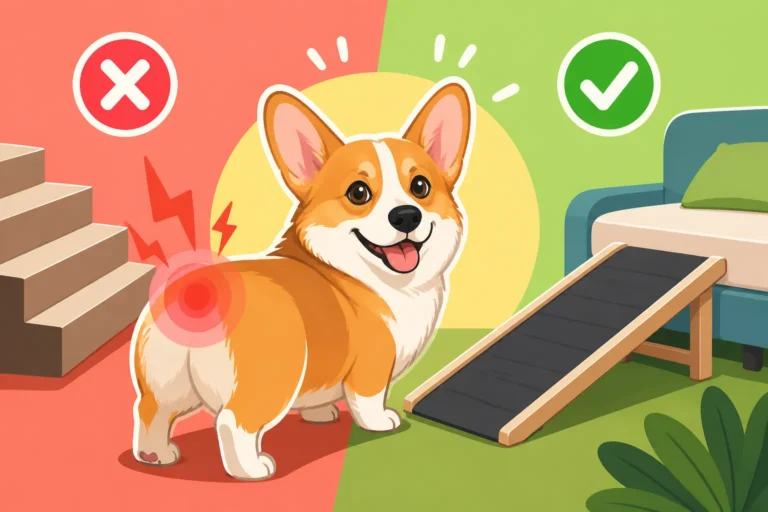
Secondly, you need to manage your Corgi's environment to protect their back. This means actively discouraging jumping off furniture, as a single awkward landing can lead to a disc injury. Installing Ramps and Steps That Save a Corgi's Back can make a world of difference, allowing your Corgi to safely access sofas, beds, and cars without risky leaps. It might seem like a small thing, but ensuring your Corgi doesn't repeatedly launch themselves from heights is incredibly important – something you can read more about in Whether a Corgi Should Ever Jump Off a Sofa. Consider the long-term view of your Corgi's The Twelve to Fifteen Year Corgi Lifespan and set them up for success.
If, despite all precautions, your Corgi ever does experience a back injury, immediate veterinary attention is critical. Having a good pet insurance policy, like those offered by Healthy Paws, can provide immense peace of mind and financial support during such stressful times, covering everything from diagnostics to surgery and physical therapy. They understand that unexpected health events happen. Post-injury, you might face periods of Crate Rest for a Corgi With a Bad Back, which is challenging but essential for healing. While supplements are often discussed, always consult your vet about Whether a Corgi Needs Joint Support in Its Bowl to ensure they're truly beneficial for your specific dog.
Disclaimer
This article is intended for informational purposes only and does not constitute veterinary advice. Always consult with a qualified veterinarian for any health concerns or before making decisions about your Corgi's medical care, including neutering timing. Individual health needs can vary, and a professional examination is essential.