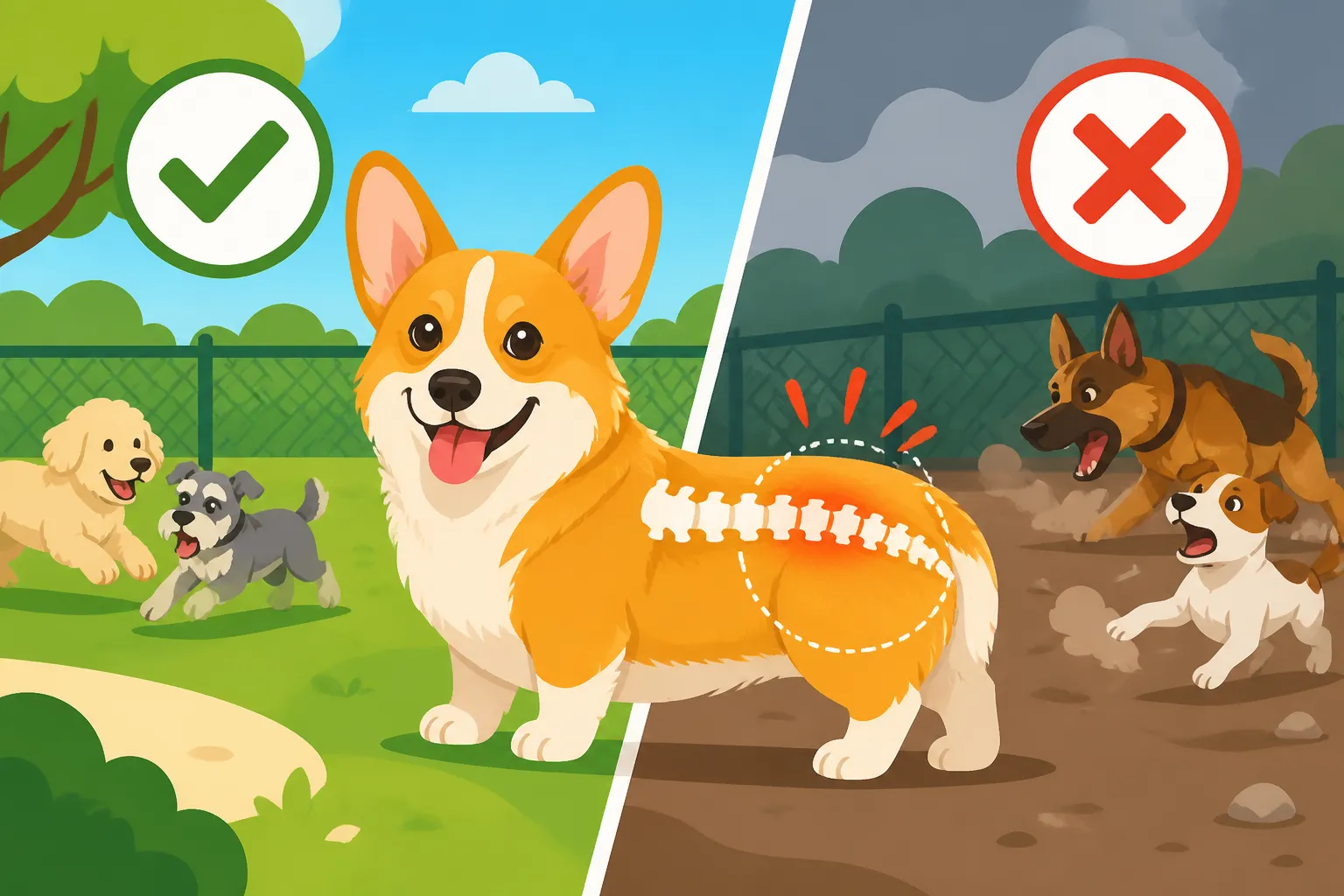
Whether a Dog Park Is Safe for a Corgi Spine
Bringing your beloved Corgi to the dog park seems like a perfect way to burn off some energy and socialize, but for many Corgi owners, a nagging worry often creeps in: what about their delicate, long backs? The truth is, the boisterous, unpredictable play that often defines a dog park environment can pose significant risks to a Corgi's unique spinal structure, leaving us constantly on edge about potential injuries. This guide will delve into the specific dangers, help you assess your dog's temperament and the park environment, and offer practical strategies to keep your Corgi safe, happy, and pain-free.
The Unique Vulnerabilities of the Corgi Spine
It's no secret that Corgis are built differently. Their distinctive long bodies and short legs are adorable, but they also come with a significant predisposition to certain health issues, particularly concerning their spine. Understanding these inherent vulnerabilities is the first step in making informed decisions about their activities, especially in high-impact environments like dog parks.
Understanding IVDD and Corgi Anatomy
Corgis, like Dachshunds and other chondrodystrophic breeds, are prone to Intervertebral Disc Disease (IVDD). This isn't just a generic "bad back"; it's a specific condition where the discs between their vertebrae degenerate prematurely, becoming brittle and prone to bulging or rupturing. Imagine a jelly donut with a hard, calcified center – that's often what a Corgi's disc becomes. When these discs rupture, they can press on the spinal cord, leading to excruciating pain, nerve damage, and even paralysis.
Their long backs mean there's more surface area for discs to be affected, and their short legs mean any impact or twisting motion is amplified along the spine. A sudden jump, a hard landing, or a playful collision can easily trigger a disc episode. Many owners have been heartbroken by a sudden crisis, realizing that what seemed like harmless fun could lead to a painful Disc Disease in a Long-Backed Corgi. It's a sobering reality that sets Corgis apart from many other breeds when it comes to rough-and-tumble play.
Recognizing the Risks of Rough Play
Dog parks, by their very nature, involve a lot of roughhousing. You see dogs of all shapes and sizes, often playing with varying degrees of intensity. For a Corgi, this can be a minefield of potential injury. A larger, more exuberant dog might accidentally run into your Corgi, sending them tumbling. A chase game could involve sudden stops and sharp turns that put immense strain on their spine. Even seemingly innocent actions, like repeatedly jumping up to greet other dogs or landing awkwardly after a short leap, can contribute to disc degeneration over time or cause an acute rupture.
Think about it: a Rottweiler or a Labrador bounding around might not even notice a small Corgi in its path, but that impact could be catastrophic for your little friend. It's not about bad intentions, but simply the physics of different body types interacting. The sheer unpredictability of multiple dogs playing freely means that even if you're vigilant, you can't control every interaction, and that's where the risk lies. The problem isn't usually if an incident happens, but when, and for a Corgi, the consequences are often far more severe than a scraped knee.
Assessing Your Dog Park and Your Corgi's Temperament
Before you even consider stepping foot into a dog park with your Corgi, it's crucial to evaluate two key factors: the environment itself and your Corgi's individual personality and play style. What works for one Corgi might be dangerous for another, and what's safe at one park might be hazardous at the next.
Evaluating the Dog Park Environment
Not all dog parks are created equal. Some are sprawling, well-maintained spaces with separate areas for large and small dogs, while others are small, crowded, and poorly supervised. Observe the general vibe before letting your Corgi off-leash. Are there mostly polite, calm dogs, or is it a chaotic free-for-all with lots of aggressive or overly boisterous play? A park with predominantly larger, high-energy breeds might not be the best fit for your Corgi.
Consider the ground surface as well. Hard concrete or asphalt can be unforgiving on joints and spines, especially during sudden stops or falls. Uneven terrain, holes, or rocky patches can also lead to awkward landings or trips, increasing the risk of injury. Ideally, look for parks with soft, well-maintained grass or a sand-based surface that provides better shock absorption. Also, assess the fencing and exits – a secure perimeter is vital to prevent any accidental escapes, especially if your Corgi is prone to chasing. You might consider visiting during off-peak hours to avoid the busiest, most chaotic times.
Here's a quick checklist for evaluating a dog park:
| Feature | Ideal for Corgi Spine Safety | High Risk for Corgi Spine Safety |
|---|---|---|
| Play Style | Calm, supervised play; separate small dog area | Unsupervised, rough, high-impact play; many large, energetic dogs |
| Surface | Soft grass, sand, or well-maintained dirt | Concrete, asphalt, rocky, uneven ground, holes |
| Crowd Level | Low to moderate, plenty of space for movement | Overcrowded, confined spaces, risk of accidental collisions |
| Supervision | Engaged owners, quick to intervene if play gets too rough | Owners distracted, letting dogs sort it out, lack of intervention |
| Hazard Check | Clear of debris, stable fencing, safe exits | Broken fences, sharp objects, steep inclines/declines |
Knowing Your Corgi's Play Style and Limits
Just like people, Corgis have different personalities. Some are bold and love to wrestle, while others are more reserved and prefer to sniff around independently. Does your Corgi instigate rough play? Do they try to herd other dogs by nipping at their heels? Or are they more likely to avoid conflict and stick close to you? A Corgi that constantly throws itself into the fray, jumps off obstacles, or tries to engage large dogs in intense tug-of-war is at a much higher risk.
Observe your Corgi's body language. Are they having fun, or do they look stressed or overwhelmed? Watch for signs of fatigue, lameness, or discomfort. Even if they appear to be enjoying themselves, a Corgi's stoicism can sometimes mask underlying pain or strain until it's too late. If your Corgi is older, has a known history of back issues, or is overweight, the risks are compounded. Why Corgi Weight Is a Spinal Problem is a serious consideration, as extra pounds put even more stress on their already vulnerable discs. Be brutally honest with yourself about your Corgi's limits, even if it means sacrificing some park time.
Strategies for Minimizing Risk and Ensuring Safety
If, after careful consideration, you decide that a dog park is still part of your Corgi's routine, it's absolutely essential to implement rigorous strategies to mitigate the risks. This isn't just about passive observation; it requires active management and smart choices.
Proactive Management and Training
Your presence and intervention are your Corgi's best defense in a dog park. Don't just sit on a bench and scroll through your phone. Be actively engaged in supervising their interactions. If play starts to get too rough, intervene immediately. Call your Corgi away, put them on a leash for a short break, or redirect their attention with a toy. Teaching a solid recall command is paramount. You need to be able to reliably call your Corgi away from potentially dangerous situations. Consider using high-value treats to make recall irresistible, and practice it diligently outside of the park environment. Products like the BAXTER & Bella online puppy school often emphasize strong recall training, which is invaluable for a dog park setting.
Another critical training aspect is teaching your Corgi to avoid jumping. We love their enthusiasm, but uncontrolled jumping off park benches, play structures, or even just off-leash onto people can be disastrous for their backs. Instead of allowing them to leap, encourage them to wait to be lifted or use ramps or steps where available. This also extends to home life; Whether a Corgi Should Ever Jump Off a Sofa applies to any elevated surface. Many owners invest in portable ramps, often found on Amazon, to help their Corgis navigate elevations safely. Always be prepared to leave the park if the environment becomes too chaotic or the other dogs' play styles are incompatible with your Corgi's safety.
Alternative Socialization and Exercise Options
Frankly, for many Corgis, dog parks might simply be too risky. But that doesn't mean your Corgi has to miss out on fun, exercise, or socialization! There are plenty of fantastic alternatives that offer controlled environments and specific activities tailored to protect their precious spines.
Consider structured playdates with one or two known, friendly dogs of similar size and play style. This allows for safe, supervised interaction without the unpredictability of a large group. Enrolling in obedience classes, scent work, or even very carefully managed agility (with low jumps and focus on precision, not speed, and under the guidance of an instructor who understands Corgi biomechanics) can provide mental and physical stimulation that's much safer than a dog park. Agility With a Corgi's Back in Mind explores how to adapt these sports safely.
Daily walks on a leash, exploring new smells in a local park, or playing fetch in your fenced yard can provide ample exercise. Ramps are your Corgi's best friend. Install them wherever your Corgi likes to go, whether it's up to the sofa, onto the bed, or into the car. Ramps and Steps That Save a Corgi's Back is a vital read for any Corgi owner. These small changes can make a huge difference in protecting their spine over their lifetime. Remember, a happy Corgi isn't necessarily one that runs wild in a dog park; it's one that feels safe, loved, and gets appropriate physical and mental enrichment without risking their health. If you ever suspect a back injury, even minor signs like a reluctance to jump, difficulty with stairs, or a change in gait, consult your vet immediately. Early intervention is key if Emergency Signs of a Corgi Disc Injury appear.
Ultimately, your Corgi's health and longevity are in your hands. While the allure of the dog park is strong, it's essential to weigh the potential joy against the very real, often devastating, risks to their unique spinal structure. By understanding their vulnerabilities, carefully assessing environments, and prioritizing their safety through proactive management and alternative activities, you can ensure your Corgi lives a full, active, and most importantly, pain-free life. It’s a journey of continuous learning, but one well worth taking for these wonderful, low-riding companions.
Disclaimer
This article is for general informational purposes only and does not constitute professional advice. Laws, prices and regulations vary by location and change over time. Consult a qualified professional for guidance on your specific situation.